
Main-track train collision and derailment
BNSF Railway Company
Freight trains R-NWE8041-18I and M-VBCEVE1-18T
Mile 133.54, New Westminster Subdivision
Delta, British Columbia
The Transportation Safety Board of Canada (TSB) investigated this occurrence for the purpose of advancing transportation safety. It is not the function of the Board to assign fault or determine civil or criminal liability. This report is not created for use in the context of legal, disciplinary or other proceedings. See Ownership and use of content. Masculine pronouns and position titles may be used to signify all genders to comply with the Canadian Transportation Accident Investigation and Safety Board Act (S.C. 1989, c. 3).
Summary
On 19 November 2023, at approximately 0222 Pacific Standard Time, BNSF Railway Company freight train R-NWE8041-18I, proceeding northbound on the New Westminster Subdivision, passed a Stop signal indication and collided with southbound BNSF Railway Company freight train M-VBCEVE1-18T as it was entering Oliver siding at the north siding switch (Mile 133.54) in Delta, British Columbia. On the southbound train, 2 multi-platform intermodal cars derailed. On the northbound train, 2 locomotives and 5 cars derailed upright, including 2 tank cars loaded with liquefied petroleum gas (UN1075) and 1 residue tank car last containing liquefied petroleum gas. In addition, the fuel tank on the east side of the lead locomotive sustained extensive damage, releasing approximately 8000 litres of diesel fuel. No injuries were reported.
1.0 Factual information
1.1 New Westminster Subdivision
The New Westminster Subdivision is owned by BNSF Railway Company (BNSF) and traverses the Vancouver metropolitan area (Metro Vancouver) in British Columbia (BC).All locations are in the province of British Columbia, unless otherwise indicated. The route, which passes through the cities of Delta and Surrey, includes a mix of industrial districts, residential areas, farmland, and environmentally sensitive locations.
The subdivision begins at the U.S.–Canada border (Mile 119.60), where it connects to the Bellingham Subdivision to the south. From there, it extends northward to Fraser River Junction (Mile 141.30).
Northward, from the border to Colebrook (Mile 130.80), the subdivision consists of a single main track. From Colebrook, train movements continue along a 3500-foot section of east–west running double track that forms part of the British Columbia Railway Company (BCR)’s Port Subdivision. The New Westminster Subdivision then resumes as a single main track and diverges northward at Mud Bay West (Mile 131.50), where there is also a right turnout for the Oliver south siding switch (Mile 131.48). The siding measures 10 539 feet and ends at the Oliver north siding switch (Mile 133.54) (Figure 1).
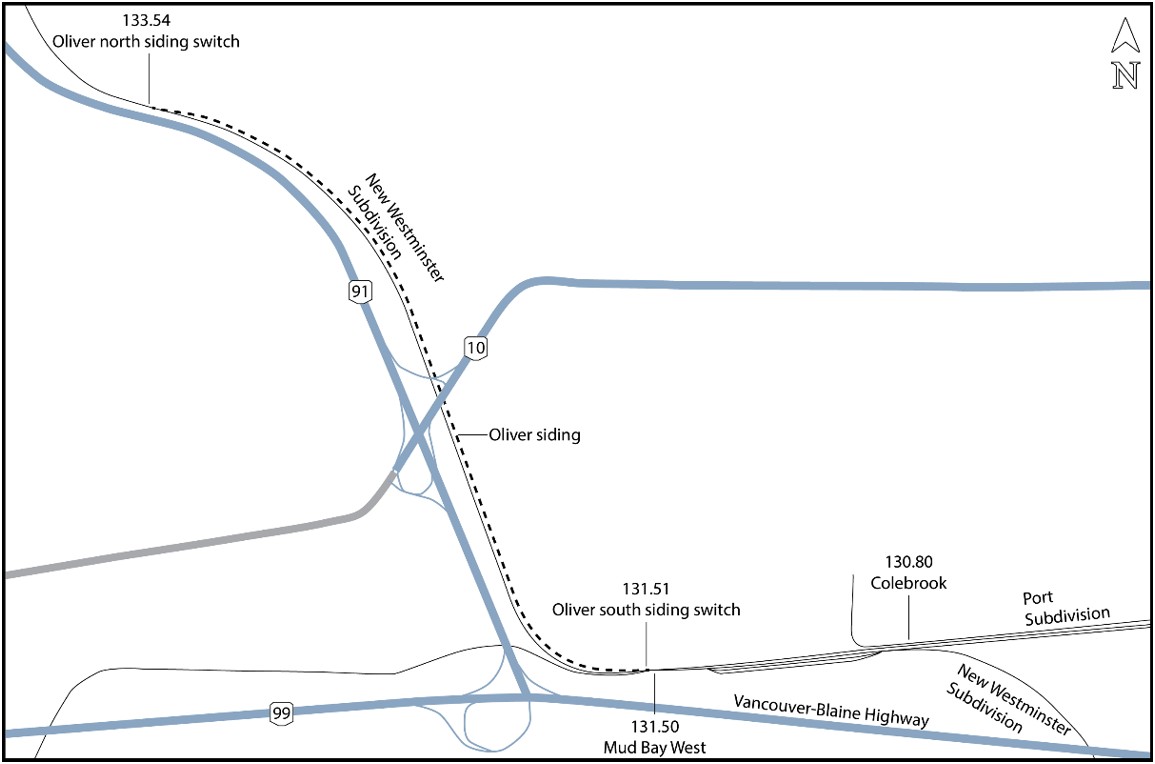
Oliver siding is in the city of Delta. In the vicinity of the siding, the track runs parallel to a major north-south transportation corridor that includes Highway 91 (a divided 4-lane arterial highway), the Delta–South Surrey Regional Greenway, and a 1.2-metre-diameter high-pressure underground pipeline that transports sewage to a wastewater treatment plant.
Train movements on the subdivision are controlled by the centralized traffic control (CTC) system, as authorized by the Canadian Rail Operating Rules (CROR). However, the subdivision is equipped with a U.S.-based signal system, as permitted under the CROR and authorized by Transport Canada (TC).
Movements on the New Westminster Subdivision are dispatched by a BNSF rail traffic controller (RTC) located in BNSF’s Network Operations Center in Fort Worth, Texas, United States. However, movements on the section of double track that forms part of the Port Subdivision are dispatched by a BCR RTC located in BCR’s headquarters in Delta.
1.1.1 Speed restrictions
The time table maximum permissible speed on the New Westminster Subdivision is 40 mph. From Mile 129.80 to Mile 132.00, a permanent slow order restricts train speeds to 35 mph.
The time table maximum permissible speed on the BCR Port Subdivision is 35 mph.British Columbia Railway Company, BCR Port Subdivision Time Table No 6, in effect 01 November 2023. On the day of the occurrence, there was also a 25 mph temporary slow order in effect for BNSF trains on the subdivision.
1.2 The occurrence
On 19 November 2023, at about 0030,All times are Pacific Standard Time. BNSF conventional, mixed-merchandise freight train R-NWE8041-18I (train 804) departed Cherry Point Yard in Ferndale, Washington, United States, destined for Brownsville Yard in New Westminster. The crew consisted of a locomotive engineer (LE), a conductor, and a brakeman. The LE and conductor were in the lead locomotive (BNSF 7334), while the brakeman was in the 2nd locomotive (BNSF 4002),The brakeman boarded the head-end trailing locomotive at Cherry Point Yard and remained stationed in that locomotive for the duration of the trip. As a result, train 804 was operating with a separated crew; however, under BNSF policy, all crew members retain their operational responsibilities in this crew arrangement. which was facing toward the rear of the train; the brakeman was not actively participating in train operations. The train proceeded north on the Cherry Point and Bellingham subdivisions, reaching the U.S.–Canada border at about 0146. It then continued northward on the New Westminster Subdivision.
Meanwhile, BNSF conventional, mixed-merchandise freight train M-VBCEVE1-18T (train 118) was travelling southward on the New Westminster Subdivision, en route to Everett, Washington, United States. Train 118 was routed into Oliver siding for a meet with train 804. Train 118 stopped for a pre-arranged crew change at the north end of the siding, where a private crossing provided vehicle access. The train arrived there at about 0205.
Train 804, still proceeding northward, approached Colebrook and the LE was informed by the RTC for the BCR Port Subdivision that the train was cleared through, meaning that it could proceed through the Port Subdivision on the main track. At about 0216, the train passed signal 1308N (Mile 130.80), which displayed an Approach Medium indication,Signal indications on the subdivision follow a U.S.-based signal system. and entered the Port Subdivision. This indication required that the train be prepared to pass the next signal (1315N) not exceeding 40 mph and be prepared to enter the diverging route at prescribed speed.BNSF Railway Company, Signal Aspects and Indications, 04 August 2021.
About 90 seconds later, train 804 passed signal 1315N (Mile 131.49) approaching Mud Bay West, which was displaying a Diverging Approach indication. According to this indication, trains can proceed on the diverging route not exceeding the prescribed speed through the turnout but must approach the next signal prepared to stop; trains exceeding 30 mph are required to immediately reduce to that speed.Ibid. Apart from the temporary slow order on the BCR Port Subdivision, there were no additional speed restrictions applicable through the turnouts on the train’s route.
The train was routed to rejoin the New Westminster Subdivision at Mud Bay West. The next signal—signal 1335N—was just south of the Oliver north siding switch. After the head end of the train passed signal 1315N, the train accelerated to a maximum speed of 37.5 mph.
At 0221:17, while train 804 was traversing a left curve with restricted sightlines due to a tree line on both sides of the track, the headlight of southbound train 118 became fully visible on the forward-facing camera recording.The recorded camera view may not represent the crew members’ actual line of sight at that moment, as they may have been focused on other tasks or looking outside the camera’s fixed field of view. Train 118 had just resumed movement following a crew change and was still occupying the turnout and the main track to the north of the Oliver north siding switch. The LEs of both trains dimmed their respective headlights. The LE on train 804 also reduced the throttle from position 6 to position 2.
At 0221:47, the head ends of the 2 trains met around Mile 133.32. At that point, the LE on train 804 restored the headlight to full intensity and increased the throttle to position 4.
At 0221:57, while train 804 was travelling at about 36 mph, signal 1335N (Mile 133.54), located just south of the Oliver north siding switch, came into view on the forward-facing camera recording; the signal was displaying a Stop indication. There was a slight left curve for train 804 approaching the signal, which was located to the left of the main track. The track curvature at this location was favourable for establishing a clear sightline of the signal from the lead locomotive of train 804. The distance from the lead locomotive to the signal was about 670 feet. When the Stop signal indication came into view, the LE moved the throttle to the Idle position and fully applied the locomotive independent brakes.Locomotive independent brakes are intended to be used to hold a locomotive or a consist of locomotives stationary when stopped. Outside of certain low-speed applications, locomotive independent brakes are generally not intended for use in controlling train speed.
For the next 13 seconds, as train 804 approached the signal, there was no recorded reduction in train speed. Shortly after the Stop signal indication was captured on the forward-facing camera, the remaining portion of train 118 was visible on the recording just beyond the signal as it continued entering the siding.
At 0222:10, the lead locomotive of train 804 passed the Stop signal indication at about 34 mph and the LE initiated an emergency application of the train brakes.An emergency application of the train brakes can be initiated from the LE’s controls as well as from an emergency braking valve on each locomotive, within reach of the conductor and the brakeman. About 4 seconds later, at 0222:14, the head end of train 804 collided with the side of train 118 at Mile 133.54. At the time of the collision, train 804 was travelling northward at about 34 mph while train 118 was travelling southward at about 7 mph.
Figure 2 shows the occurrence location.
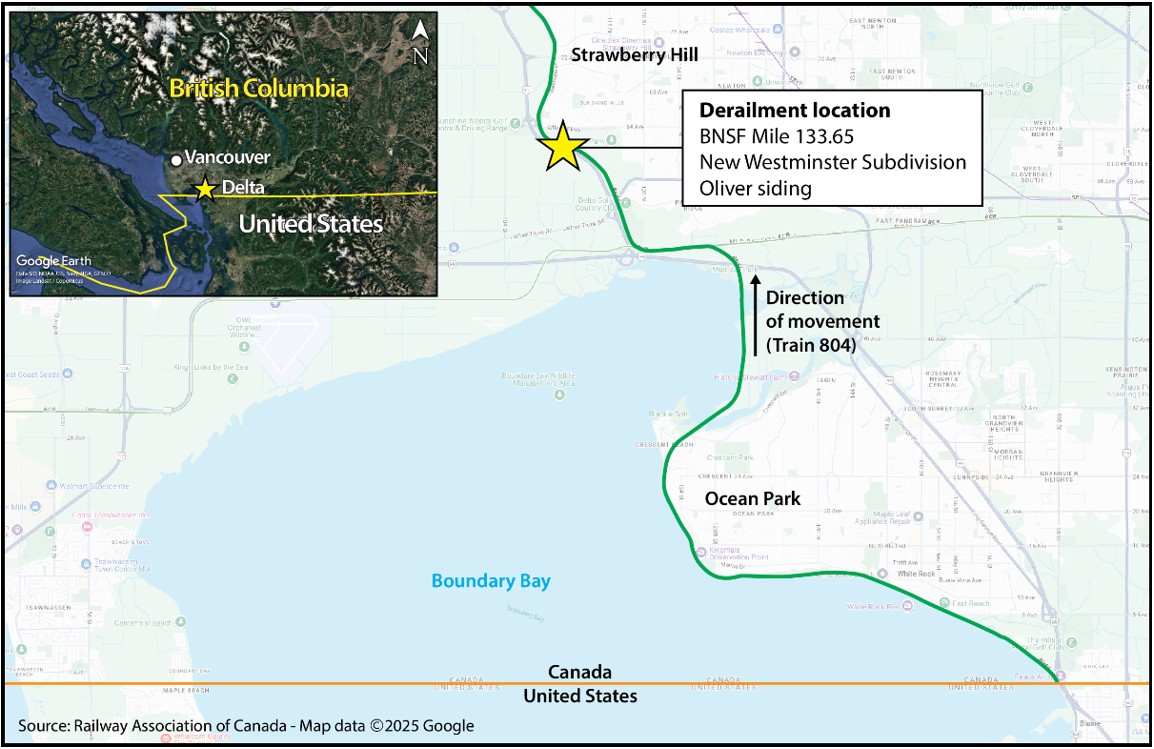
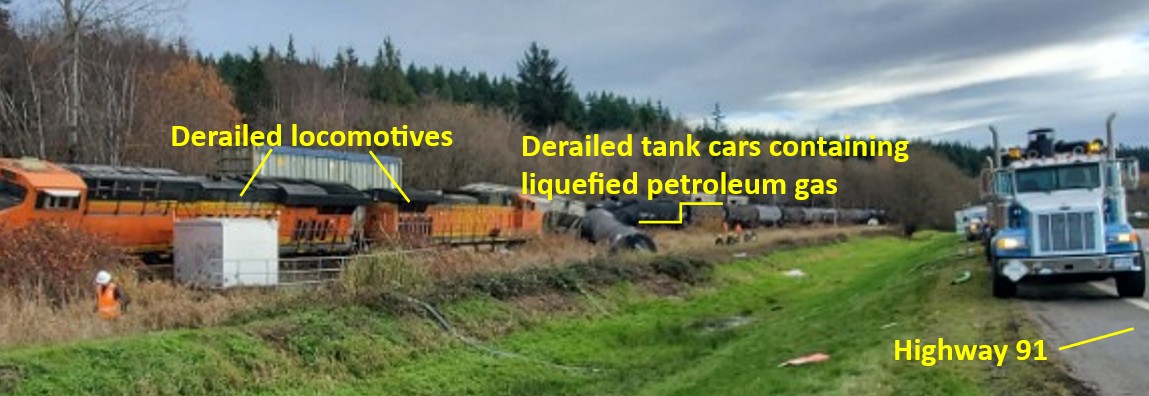
As a result of the collision, 2 multi-platform intermodal cars on train 118 (positions 8 and 9) derailed and sustained damage. This included the 2nd and 3rd platforms of the 3-platform car DTTX 620860, and the first 2 platforms of the 3-platform car BNSF 230028. On train 804, 2 locomotives and 5 cars derailed upright, including 2 tank cars loaded with liquefied petroleum gas (LPG, UN1075) and 1 residue tank car last containing LPG. Figure 3 shows the derailed rolling stock after the collision.
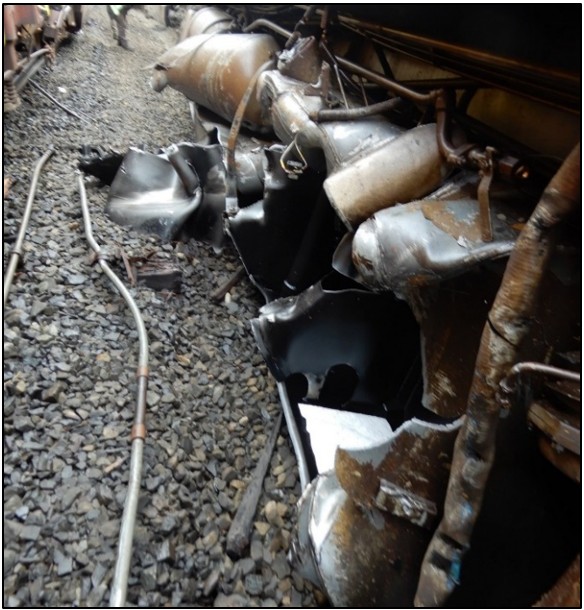
None of the derailed tank cars released product. However, the fuel tank on the east side of the lead locomotive on train 804 was extensively damaged (Figure 4), resulting in the release of approximately 8000 litres of diesel fuel. There were no injuries.
At the time of the occurrence, the temperature was 7.5 °C and it was raining.
1.3 Emergency response
1.3.1 Emergency response protocols
BNSF has established protocols for responding to occurrences and coordinating with local emergency responders. According to BNSF’s Spill Contingency Plan for BC, once notified of an incident, the BNSF Resource Operations Control Center is responsible for notifying applicable public safety and emergency response agencies.BNSF Railway Company, Spill Contingency Plan – British Columbia, Canada (May 2023), Emergency Contact Sheet, p. i. Under the Transportation of Dangerous Goods Regulations, persons involved in the transportation of dangerous goods (DG) are required to have an emergency response assistance plan (ERAP) in place.Transport Canada, Transportation of Dangerous Goods Regulations, SOR/2001-286 (last amended on 25 October 2024), Part 7: Emergency Response Assistance Plan, pp. 198–200. In the event of an incident involving a release (or anticipated release) of DG for which an ERAP is required, the ERAP must be activated and the Canadian Transport Emergency Centre of the Department of Transport (CANUTEC) must be notified.
BNSF is also subject to provincial requirements to conduct regular simulations and tests of its emergency response capabilities involving DG. Accordingly, in May 2023, BNSF conducted an exercise simulating a DG spill at Mud Bay. No issues with the process for notifying applicable public safety and emergency response services were identified during the exercise.
BNSF’s emergency response actions are further informed by the Emergency Response Guidebook, a joint publication by TC, the U.S. Department of Transportation, and the Secretariat of Infrastructures, Communications and Transport of Mexico. For incidents involving LPG, the guide recommends initiating a 911 emergency services response, securing the site to prevent unauthorized access, and remaining upwind and/or upstream of the release. As an immediate precaution, the area should be isolated for at least 100 metres (330 feet) in all directions. Diesel fuel is classified as a flammable liquid and similarly requires a 911 emergency services response, with an initial isolation zone of at least 50 metres (150 feet).U.S. Department of Transportation, Transport Canada, and Secretaría de Infraestructura, Comunicaciones y Transportes (Mexico), Emergency Response Guidebook (2020).
1.3.2 Emergency call requirements
In the event of an emergency, CROR Rule 125 requires that an emergency radio broadcast be made to warn other trains in the area that may be affected and to inform the RTC of the situation. Additionally, section 23.10 of the BNSF Employee Safety Rules requires the following:
Emergency calls will begin with the words “Emergency,” “Emergency,” “Emergency.” These calls will be used only to cover initial reports of derailments, collisions, storms, washouts, fires, track obstructions, property damage, or injury to employees or the public. Emergency calls must contain as much complete information on the incident as possible.BNSF Railway Company, Employee Safety Rules (2015), Railroad Radio Rules, Emergency Calls, 01 January 2015, p. 80.
In this occurrence, an emergency call was not made by the crew of train 804 immediately after the collision.
1.3.3 Emergency response in this occurrence
Following the collision, the conductor of train 804 radioed the crew of train 118. Both the conductor and the LE of train 804 then retreated to the 2nd locomotive in the head-end consist to determine if the brakeman was injured. While moving between locomotives, they discovered that the head-end locomotive was coated in diesel fuel, contaminating their clothes and presenting a strong odour. Concerned with the possibility of fire, all crew members egressed from the locomotives, secured hand brakes as necessary, and moved away from the equipment, eventually making their way to the head end of train 118.
The crew of train 118, after speaking with the crew of train 804, radioed the RTC indicating that a derailment had occurred and that there may be fuel spilled, but that there were no reported injuries.
After receiving this information, the RTC contacted the local trainmaster and a BNSF police officer based in BC, who were both dispatched to the site. He also notified a BNSF DG officer in Washington State (who, in turn, notified CANUTEC as required) and a DG response contractor in BC. However, BNSF did not contact local 911 emergency services in BC; consequently, Metro Vancouver emergency first responders were not immediately contacted.
The RTC did not speak directly to the crew of train 804. However, over the next 20 minutes, he received updates, including one from the responding trainmaster and another from the crew of train 118.
Within a half hour of the occurrence, the Delta Police Department received a public report of a train derailment near Highway 91 and contacted the BNSF Resource Operations Control Center in Fort Worth. During the call, which took place at about 0247, BNSF informed the Delta Police Department that there were no safety concerns and that no assistance from local emergency services was required.
At about 0730, the DG response contractor arrived on site to assess the situation. It was determined that 3 derailed tank cars were involved: 2 cars loaded with LPG and 1 residue car that last contained LPG. One of the loaded tank cars had come off its truck and embedded itself into the ground adjacent to the track, burying the bottom of the car.
A site survey was performed, and it was confirmed that 1 of the fuel tanks on the lead locomotive of train 804 had ruptured during the collision, releasing its contents. Evidence of fuel contamination was also observed on the surface of the water in a nearby drainage ditch and liquid containment booms were deployed on the water surface. Vacuum trucks were used to begin the recovery of spilled diesel and contaminated runoff.
The Delta Fire and Emergency Services department was notified of the derailment around 1000.
By 1245, emergency response officials in Metro Vancouver had established a formal incident command structure to coordinate response efforts and protect nearby utility infrastructure.
1.4 BNSF Railway Company
BNSF is one of North America’s largest freight railways, operating approximately 32 500 route-miles of track across 28 U.S. states and 3 Canadian provinces. Its Canadian operations account for approximately 0.33% of its total network, comprising 90 miles and handling about 500 000 carloads annually. Train crews operating BNSF trains between British Columbia and Washington State are based in the United States. BNSF also employs Canadian personnel at rail yard facilities located in Vancouver, New Westminster, and Brownsville.
1.4.1 BNSF training and qualification of conductors and locomotive engineers
BNSF has a conductor and LE training program. Experienced conductors interested in becoming LEs can apply for training and be selected in seniority order, based on need. However, when there is a shortage of qualified LEs, the company can compel a conductor to qualify as an LE. In both the United States and Canada, there is no minimum qualified service requirement for railway employees prior to commencing LE training.
1.5 Train information
1.5.1 Train 804
Train 804 is a daily assignment operated in turnaround serviceAssignments operated in turnaround service return to their originating station at the completion of the shift. with a 3-person crew consisting of an LE, a conductor, and a brakeman. The crew comes on duty at the BNSF Swift depot in Blaine, Washington, United States, and travels by road vehicle to Cherry Point Yard in Ferndale, where they assemble their train and perform the required brake test. From Cherry Point Yard, the train travels northward on the Cherry Point and Bellingham subdivisions and enters the Swift siding in Blaine (Mile 116.40 of the Bellingham Subdivision), where it clears customs. Once cleared to travel north across the border, the train is operated to Brownsville Yard in New Westminster. At Brownsville Yard, the crew yard their train and then assemble a train for the return trip.
In this occurrence, train 804 was a conventional, mixed-merchandise freight train consisting of 2 head-end locomotives and 48 cars, including 2 buffer cars loaded with sand, 2 tank cars loaded with LPG, 2 empty cars, and 42 DG residue tank cars. The train measured 3307 feet and weighed 3067 tons.
1.5.2 Train 118
Train 118 was a conventional, mixed-merchandise freight train consisting of 2 head-end locomotives and 77 cars, including multi-platform intermodal and single cars. The consist comprised 35 loaded cars (including 12 loaded 3-platform intermodal cars at the head end), 40 empty cars, and 2 DG residue tank cars. The train measured 6391 feet and weighed 7441 tons.
1.6 Crew information
1.6.1 Train 804
On the night of the accident, train 804 was crewed by an LE and a conductor who were in the spare pool, and a brakeman who normally worked the train 804 assignment, up to 5 shifts per week.
According to the limited data provided to the investigation, it was impossible to determine whether the crew’s performance was negatively affected by medical or physiological factors, including fatigue. However, the occurrence happened at a time of day known to be a circadian low point for people.
1.6.1.1 Locomotive engineer
The LE was hired by BNSF in 2022. After qualifying as a conductor, he worked in that role for 1 month before entering LE training. He qualified as an LE in February 2023 and was rules-qualified to operate on BNSF track in Canada. By the time of the occurrence, he had completed several trips on the New Westminster Subdivision.
1.6.1.2 Conductor
The conductor qualified in August 2023. During training, he completed 1 trip into Canadian territory. After qualifying, he made several trips southbound on the New Westminster Subdivision.
1.6.1.3 Brakeman
The brakeman was hired by BNSF in July 2017. He was qualified for his position and familiar with the territory. The brakeman was also a qualified conductor.
1.6.2 Train 118
The crew consisted of an LE and a conductor based out of Everett.
1.7 Recorded information
1.7.1 Locomotive event recorder
The investigation reviewed the data obtained from the locomotive event recorder on the lead locomotive of train 804. Select events from these data are provided in Appendix A.
1.7.2 Forward-facing camera
The lead locomotive of train 804 was equipped with a forward-facing camera. The recording from the camera shows that signal 1308N was displaying an Approach Medium indication, signal 1315N was displaying a Diverging Approach indication, and signal 1335N was displaying a Stop indication. Within the camera’s field-of-view, the signals were clearly visible in the nighttime darkness.
The recording also revealed intermittent light, consistent with a flashlight, being directed from the right side of the locomotive toward the right-of-way on the east side. In 1 instance, the beam swept from east to west and then back toward the east across the track ahead of the locomotive. Flashlight beam activity was visible at the following locations:
- Mile 119.90, while the train was passing through White Rock
- Mile 122.96, just north of White Rock
- Mile 127.60, just north of the Mud Bay swing bridge
- Mile 130.80, just after passing the signal at Colebrook
- Mile 131.37, just before passing the signal at the Oliver south siding switch
The investigation determined that a flashlight was used to spot wildlife in the darkness on the right-of-way to the east side of track while the train was in motion. Although the precise source of the flashlight beam cannot be confirmed with absolute certainty, the orientation and movement of the beam—particularly its apparent origin point, angle, and sweep pattern—are most consistent with it emanating from just outside the LE’s side window on the right side of the operating cab.
1.7.3 Locomotive voice and video recorder
Under the Locomotive Voice and Video Recorder Regulations (LVVR Regulations), railway companies operating in Canada are required to ensure that a locomotive voice and video recorder (LVVR) system is installed and operational on each controlling locomotive.In rail operations, the controlling locomotive is the one whose throttle, brakes, and other controls are actively being used to operate the train. In this occurrence, the lead locomotive was the controlling locomotive.
However, there are exceptions. For instance, the regulations do not apply to railway companies whose gross revenues from rail services in Canada were less than $250 million in each of the 2 preceding calendar years, or to companies operating controlling locomotives over fewer than 5 miles of track in Canada. Based on these provisions, BNSF is exempt from the requirement to operate LVVR systems on its locomotives while in Canada.
Although BNSF locomotives are equipped with locomotive image and audio recording devices, a geofencing feature disables these devices when the locomotive crosses into Canadian territory. U.S. regulations do not mandate inward-facing cameras or audio recorders for freight locomotives. BNSF’s installation of inward-facing cameras is a voluntary safety measure.
Finding: Other
The absence of image and audio recordings from within the locomotive cab limited the information available to assess the communications between the train crew members.
1.8 Rules governing crew responsibility for safe train operations
Federally regulated railway operations in Canada are subject to the CROR.
The CROR and BNSF instructions both contain several references to operating crews’ responsibilities with respect to safe train operations and safety in general.
The safe operation of train movements is the direct responsibility of train crews. CROR Rule 106 states in part:
All crew members are responsible for the safe operation of movements and equipment in their charge and for the observance of the rules. Under conditions not provided for by the rules, they must take every precaution for protection. [...]Canadian Rail Operating Rules (01 October 2022, approved by Transport Canada on 09 May 2022), Rule 106: Crew Responsibilities, p. 46.
BNSF TY&E Safety Rules state the following:
- “Assure that you are alert and attentive when performing duties.”BNSF Railway Company, TY&E Safety Rules (01 January 2015, including updates through 01 March 2018), section S-1.2.3: Alert and Attentive, p. 6.
- “Warn co-workers of all unsafe practices and/or conditions.”Ibid., section S-1.2.4: Co-Workers Warned, p. 6.
The Industry’s General Code of Operating Rules, adopted by BNSF, further states:
- “When possible, crew members on the head end of freight trains must ride in the control compartment of the engine. When riding on the head end, the conductor will ride in the control compartment.”General Code of Operating Rules Committee, General Code of Operating Rules (01 April 2020), Rule 1.30: Riding Engine, p. 1-9.
When crew members are not all in the cab during a trip, it can hinder crew resource management (e.g. communication, team situational awareness, and team cohesion). It also removes the value of an additional perspective assessing operations.
In this occurrence, the brakeman was in the trailing head-end locomotive and was not actively participating in train operations.
1.9 Signal indications
1.9.1 Centralized traffic control system
CTC is a system of interconnected track circuits, switches, and signals in the field that is used by a railway to control train routes remotely. Computer displays and controls are located in the RTC office.
Signal indications convey information to train crews that indicate the speed at which they may operate. In addition, signal indications provide protection against certain conditions, including if the blockA block is “[a] length of track of defined limits, the use of which by a movement is governed by block signals”. [Source: Canadian Rail Operating Rules (01 October 2022, approved by Transport Canada on 09 May 2022), Definitions, p. 8.] ahead is occupied, a rail is broken, or a switch is left open. Signals are actuated in the field by the presence of rolling stock on the track that completes track circuits.
In the RTC office, track occupancy is displayed on the RTC’s computer screen. Track occupancy normally indicates the presence of a train but can also be an indication of an interrupted track circuit (e.g., a broken rail or a switch left open). The RTC can control certain signals (controlled signals)A controlled signal is “[a] CTC block signal which is capable of displaying a Stop indication until requested to display a less restrictive indication by the RTC”, and a controlled location is “[a] location in CTC the limits of which are defined by opposing controlled signals”. [Source: Ibid.] by requesting that they display either a Stop indication or a permissive indication. When an RTC requests a route for a train, the signal system determines how permissive the indication will be based on the presence of other track occupancies and how many consecutive signals have been requested.
CTC cannot override the locomotive control settings selected by the LE (such as throttle, train air brake, and locomotive independent or dynamic brake) to slow or stop a train before it passes a signal displaying a Stop indication or another point of restriction.
1.9.2 Signal aspects and indications used by BNSF on the New Westminster Subdivision
CROR Rule 404 establishes standard signal aspects and indications used by all railways. It states:
404. STANDARD INDICATIONS
The illustrations in Rules 405–440 are standard aspects and indications. Other signal aspects and indications necessary will be illustrated in special instructions.Ibid., Rule 404, p. 69.
The CROR provides the following additional information about special instructions:
“Special Instructions will be found in time tables, general operating instructions, operating bulletins or GBO [general bulletin orders]. They may be appended to or included within copies of the Canadian Rail Operating Rules but do not diminish the intent of the rule unless official exemption has been granted.Ibid., General Rules, Rule B, p. 16.
BNSF trains operating on the New Westminster Subdivision use signal aspects and indications defined in special instructions, as authorized under CROR Rule 404.
1.9.2.1 Signal indications in this occurrence
Signal indications encountered by train 804 on the New Westminster Subdivision are summarized in Table 1.
Signal number | Mile point | Signal aspect | Indication name | Indication description | |
|---|---|---|---|---|---|
1308N | Mile 130.80 |
Image

(yellow over yellow) | Approach Medium | Proceed prepared to pass the next signal not exceeding 40 mph and be prepared to enter diverging route at prescribed speed. | |
1315N | Mile 131.49 |
Image

(red over yellow over red) | Diverging Approach | Proceed on the diverging route not exceeding the prescribed speed through the turnout; approach the next signal prepared to stop. Trains exceeding 30 mph must immediately reduce to that speed. | |
1335N | Mile 133.54 |
Image

(red) | Stop | Stop. | |
1.9.3 Signal recognition and compliance
Signal recognition and compliance is governed by CROR Rule 34 (Fixed Signal Recognition and Compliance). Rule 34 states that crew members within physical hearing range must clearly communicate the indication by name of each fixed signal they are required to identify.Ibid., Rule 34, pp. 27-28. These instructions are followed by a list of signals that must be communicated, which includes block signals,A block signal is “[a] fixed signal at the entrance to a block to govern a movement entering or using that block.” [Source: Ibid., section 1 – Definitions, p. 8] interlocking signals,An interlocking signal is “[a] fixed signal at the entrance to or within interlocking limits to govern the use of the routes.” (Source: Ibid., p. 10) and Stop signals.
In addition to calling signal indications to each other within the locomotive cab, train crews are also required to broadcast some signal indications over the radio. CROR Rule 578 states, in part:
(a) Within single track, a member of the crew on all trains or transfers must initiate a radio broadcast to the airwaves on the designated standby channel stating the name of the signal displayed on the advance signal to the next controlled location, controlled point or interlocking.Ibid., Rule 578: Radio Broadcast Requirements, p. 88.
In this occurrence, the crew members within the cab of the lead locomotive of train 804 did not call the signals or engage the brakeman by radio with the indications displayed. There were no broadcasts made over the airwaves on the designated standby channel to announce the name of the signal displayed on the advance signal to the next controlled location.
1.10 Human factors issues associated with train operations
In railway operations, a variety of human factors issues can have an influence on the outcome of any given situation. In a complex system, such as rail transportation, rules provide a framework for safe operations; however, even motivated and experienced employees remain subject to slips, lapses,A slip or a lapse is an inadvertent or unintentional execution error during a given operation. adaptations,An adaptation is a deliberate deviation from a formal rule or procedure. These are often shortcuts that occur in repetitive jobs to make operations easier or gain some perceived operational efficiency. or other mistakes that characterize human behaviour.
1.10.1 Situational awareness
Situational awareness is the perception of the elements in the environment, the comprehension of their meaning, and the projection of their status in the future.M. R. Endsley, "Toward a Theory of Situation Awareness in Dynamic Systems", Human Factors, Volume 37, Issue 1 (1995), pp. 32–64. In a dynamic environment, situational awareness requires individuals to continuously extract information from the environment, integrate this information with relevant internal knowledge to create a coherent mental model of the current situation, and use this model to anticipate future events. Situational awareness depends heavily on experience and familiarity with the environment.Ibid.
Crew members must have a shared situational awareness; that is, each crew member’s awareness of a situation such as a signal indication is consistent with that of the other crew members. It is important that each crew member establish this situational awareness, but it is also important that they communicate to establish and maintain a shared situational awareness.E. Salas, C. Prince, D. P. Baker, and L. Shrestha, “Situation awareness in team performance: Implications for measurement and training”, Human Factors, Vol. 37, No. 1 (1995), pp. 123–136.
1.10.2 Mental models and expectations
People use their experience and knowledge to rapidly categorize the situation they are experiencing, expect what is to happen next, and select an appropriate course of action based on these expectations.G. Klein, “Naturalistic decision making,” Human Factors, Vol. 50, No. 3 (2008), pp. 456–460. In highly practised situations, attention and expectations are often driven by a person’s existing mental model of the situation, given that previous experience will dictate what information is important and how the situation will unfold.Ibid. A mental model is an internal construct that enables people to describe, explain, and predict events and situations in their environment.E. Salas, F. Jentsch, and D. Maurino, Human Factors in Aviation, 2nd Edition (Academic Press, 2010), p. 66. When a mental model is adopted, it is resistant to change. New convincing information must be assimilated to change the mental model. An inaccurate mental model will interfere with situational awareness, notably in the perception of critical elements or the comprehension of their importance.M. R. Endsley, “Situation Awareness in Aviation Systems”, in J. A. Wise, V. D. Hopkin, and D. J. Garland, Handbook of Aviation Human Factors, 2nd Edition (Boca Raton, FL: CRC Press, 2010), Part II: Human Capabilities and Performance, Chapter 12, p. 12.
Mental models are critical for effective performance in dynamic time-critical environments because they reduce the need for time-consuming evaluation of the situation and enable quick actions. However, when mental models of situations are inaccurate, they can also lead to errors in how information is perceived, making it less likely for a train crew to detect information that is the opposite of what is expected, and to reassess the initial assessment.A. Tversky and D. Kahneman, “Causal schemas in judgments under uncertainty”, in D. Kahneman, P. Slovic, and A. Tversky (eds.), Judgment under uncertainty: Heuristics and biases (New York, NY: Press Syndicate of the University of Cambridge, 1982).
As mental models of a system play a critical role in supporting situational awareness, inexperienced employees and employees unfamiliar with their environment may have poorer situational awareness and rely on strong but erroneous mental models, which can degrade perception of relevant elements and comprehension of their meaning.M. R. Endsley, "Toward a Theory of Situation Awareness in Dynamic Systems", Human Factors, Volume 37, No. 1 (1995), pp. 32–64.
1.10.3 Train crew perception of signal indications displayed in the field
Train crew awareness of signal indications displayed in the field relies on visual detection and perception. A train crew’s accurate and timely visual perception of signal indications is essential for compliance. The visual perception of signal indications and the associated crew action is a sequential process requiring the following steps: detect and see, identify and call, confirm between crew members, and adjust train speed accordingly.
Familiarity with a territory improves a train crew’s knowledge of signal locations and enables crew members to take forward-planning (proactive) measures to detect and see signals. The knowledge of signal locations in a specific territory increases with the frequency of trips. When less familiar with a territory, train crews can refer to track schematics, which identify the location of each signal. Alternatively, signals can be detected without prior knowledge of their locations; this is considered reactive, as opposed to proactive, detection.
When signal indications are not obscured or obstructed and there is good visibility,Provided that visibility is not reduced by weather conditions, railway signals are typically most conspicuous during nighttime operations, when their illumination contrasts sharply with the surrounding darkness. signal perception can be accomplished rapidly from relatively long distances. However, signal perception can be affected by a crew’s fitness for duty, distraction, as well as mental models and expectations.
1.10.4 Closed-loop communications
Closed-loop communication is a practice used to avoid misunderstandings and requires that, when the sender communicates a message, the receiver repeats the message back and the sender confirms whether the message has been received accurately. While this approach is required for written authorities (e.g., CROR Rule 136) and, radio communications, it is not typically used for routine in-cab verbal communications, where rules such as CROR Rule 34 apply.
CROR Rule 34 does not require full closed-loop communication. When a train encounters a signal indication in the field, one crew member must communicate the signal indication aloud within the locomotive cab to the other crew member. While the other crew member is also required to communicate the signal indication aloud, there is no requirement for the original sender to confirm that the message was received accurately or understood by the other crew member.
1.10.5 Human reaction time
Reaction time to a stimulus is the interval between the time something is perceived and the time it takes to respond to it. This interval can range from less than a second to many seconds.
The reaction time is influenced by situational awareness in that it depends on the perception of the stimulus, its comprehension, and its projection into the future. Operators’ reaction times increase considerably as a function of a situation’s complexity and unexpected stimuli.American Association of State Highway and Transportation Officials, A Policy on Geometric Design of Highways and Streets, 6th Edition (2011).
1.11 System safety defences in signalled territory
1.11.1 Administrative defences
To mitigate operational hazards, the railway industry in Canada relies heavily on administrative defences such as rules, policies, and procedures, and on employees’ adherence to these requirements.
In signalled territory, the primary administrative defence is compliance with the CROR, which govern all federally regulated railways in Canada. For these rules to be effective, initial training, re-examination every 3 years, as well as monitoring of compliance are essential.
The effectiveness of the rules governing signal indications depends on a train crew’s ability to detect signal indications, interpret them correctly, and respond appropriately. To do this, a train crew relies on environmental cues, prior experience, and memory.
In the complex and dynamic environment of rail transportation, situational awareness requires the train crew to continuously extract information from the environment and integrate it with their knowledge to create a coherent mental model of the situation that helps prioritize information and anticipate future events. In familiar territory, attention and expectations are driven by the crew’s existing mental model. However, attention is a limited cognitive resource that can be diverted from a primary task by external stimuli or internal thoughts.U.S. Department of Transportation, Federal Railroad Administration, Why do Passenger Trains Pass Stop Signals? A Systems View, DOT/FRA/ORD-19/19, Final Report (June 2019), p. 47, at https://railroads.dot.gov/sites/fra.dot.gov/files/2019-12/Passenger%20trains%20pass%20stop%20signals2.pdf (last accessed 01 April 2026). When attention is directed toward information that is not critical to the task, it becomes a distraction. Distractions can impair the crew’s ability to detect and recognize signal indications. Memory lapses can also affect accurate recall of signal indications, particularly when attention is divided across multiple tasks.Ibid., p. 50 As attentional demands increase for other tasks, the retrieval of previously acquired information—such as the aspect of a recently observed signal—may be compromised.
These inherent limitations in human cognition are involuntary and cannot be entirely mitigated through training or procedural reinforcement. As a result, under certain conditions, signal indications may be missed, misinterpreted, or incorrectly recalled. When this occurs, the primary administrative defence fails.
To provide additional layers of defence, some railways have implemented company-specific procedures to supplement the CROR rules governing signal compliance.
For instance, to reduce or eliminate distractions, VIA Rail Canada Inc. (VIA) has introduced the cab red zone—special procedures that require crew members to cease non-essential communication and tasks during safety-critical operations. Canadian National Railway Company and Metrolinx have introduced similar procedures known as the critical focus zone. Although both these procedures are designed to reinforce crew focus, they remain subject to the same limitations as other administrative defences: if crew members do not recognize the conditions that place them in such zones, the defence is compromised.
Administrative defences, even when layered, still rely on strict crew adherence and remain vulnerable to the inherent limitations of human cognition. These limitations underscore the need for additional layers of defence that do not rely solely on crew compliance to ensure the safe operation of trains.
1.11.2 Physical defences
To supplement administrative defences in signalled territory, railway operations in many countries have implemented physical defences in the form of advanced train control systems. These automated systems are designed to intervene when crews take inappropriate actions in response to signal indications. The term “advanced train control system” does not refer to a single technology or proprietary system, but rather to a group of certified implementations that function as safety overlays on top of existing train control systems. Examples include the European Train Control System (ETCS), the Automatic Train Stop – Pattern (ATS-P) system in Japan, the Advanced Train Management System (ATMS) in Australia, and the positive train control (PTC) system in the United States. Appendix B provides an overview of the PTC implementation in the United States.
Canada has not yet implemented an advanced train control system. Canadian railways continue to rely on administrative defences. However, BNSF Railway has voluntarily implemented PTC on the New Westminster Subdivision. The absence of mandatory physical, fail-safe defences capable of intervening to stop a train or control train speed to mitigate the risk of occurrences has been raised in TSB investigation reports since 1995.TSB Railway Investigation Report R95V0174. Crews not following signal indications has been cited as a cause or contributing factor in 27 TSB investigation reports,TSB rail transportation safety investigation reports R24D0070, R24C0020, R23Q0022, R23H0006, R23D0108, R19W0002, R18D0096, R16T0162, R16E0051, R15V0183, R15D0118, R14T0294, R14D0011, R13Q0001, R13C0049, R12T0038, R11E0063, R10V0038, R10Q0011, R09V0230, R07E0129, R99T0017, R98V0183, R98V0148, R96Q0050, R95V0218, and R95V0174. and this issue has been on the TSB Watchlist since 2012.TSB, “Not following signal indications,” at https://www.bst.gc.ca/eng/surveillance-watchlist/rail/2025/rail-01.html (last accessed 01 April 2026). The TSB has issued 3 recommendations calling for additional backup safety defences (i.e., physical fail-safe train controls) in signalled territory—in 2000, 2013, and 2022 (Appendix C).
TC has been working with railway companies and industry stakeholders on potential solutions for advanced train control in Canada. In 2013, TC established the Train Control Working Group under the Advisory Council on Rail Safety to examine fail-safe train control systems. The working group studied the feasibility of implementing various levels of train control in Canada. In 2016, it published its findings and concluded that a one-size-fits-all approach would not be appropriate for Canada, given the diversity of railway operations, geographic conditions, and risk profiles. Instead, it recommended a targeted, risk-based, rail corridor-specific implementation of an advanced train control system as the most suitable option. Since then, TC has taken steps to lay the groundwork for this solution, referred to as enhanced train control (ETC).
In February 2022, TC published a Notice of Intent,Government of Canada, Canada Gazette, Part I, Vol. 156, No. 6 (05 February 2022). outlining the path forward for ETC in Canada. The notice described a high-level policy direction and the intent to develop supporting governance structures, technical specifications, and interoperability standards. However, several of these activities remain incomplete, and no binding regulatory framework, enforceable timeline, or finalized implementation plan has been established. Because of the magnitude and complexity of some of these critical activities, their implementation could take several years to complete.
Implementing an advanced train control system is a complex and capital-intensive undertaking. Despite this, PTC was implemented in about 12 years, following its mandate under the Rail Safety Improvement Act of 2008. As of year-end 2020, PTC was fully operational on 57 536 route-miles of high-risk U.S. rail corridors, representing approximately 41% of the nearly 140 000 route-miles in the U.S. rail network. This includes PTC-equipped track segments operated by Canadian Class I railways in the United States: CN (3107 miles) and Canadian Pacific Railway Company, doing business as CPKC (2118 miles). By comparison, Canada’s rail network comprises about 26 000 route-miles, with 10 940 miles of main track accounting for roughly 42% of the total network.
Following the investigation into a 21 November 2023 occurrence, in which a CN freight train collided with the tail end of a stationary commuter train, resulting in injuries to 4 passengers and 2 crew members,TSB Rail Transportation Safety Investigation Report R23D0108. the Board indicated that the risks associated with a failure to comply with signal indications remain high, and that it is unlikely that the level of risk will be significantly reduced before physical fail-safe defences are implemented. Pending implementation of ETC in Canada, no interim measures are required or planned by TC to reduce the risk of train collisions. Consequently, in the coming years, there will be few or no regulatory physical defences to stop a train when a crew does not follow a signal indication. In September 2025, the Board therefore recommended that
the Department of Transport immediately implement additional interim measures to mitigate the risks associated with train crews not complying with railway signal indications, such as collisions between trains, until adequate and permanent physical fail-safe defences are implemented.
TSB Recommendation R25-01
In December 2025, TC responded that it agrees with Recommendation R25-01 and is committed to advancing the ETC initiative. TC also submitted that, since signal adherence involves multiple risks such as human error, fatigue, and misinterpretation, it intends to advance an interim action plan until ETC is fully operational. TC will focus on revising rules to strengthen compliance, improving oversight and fatigue management to address human factors, and exploring short-term technological solutions that can provide signal safety alerts to operating crews.
In its January 2026 assessment of TC’s response, the Board acknowledged TC’s stated commitment to advance ETC. However, the Board noted that TC did not commit to any specific solutions or timelines to mitigate the risks associated with train crews not complying with railway signal indications until the implementation of fail-safe train controls in Canada.
The Board stated that, until TC provides details of its action plan, including timelines for the implementation of additional interim measures to mitigate the risks associated with crews not following signal indications, it is unable to assess the response to Recommendation R25-01.
1.11.2.1 Industry initiatives
Beyond VIA’s cab red zone, and CN and Metrolinx’s critical focus zone, some railways have implemented additional defences that include a physical component. For example, Quebec North Shore and Labrador Railway (QNS&L) has implemented a combined administrative and physical defence system, which it calls the proximity detection device (PDD) system. The PDD system uses global positioning system (GPS) technology to determine the position, direction, and speed of locomotives and maintenance vehicles, alerting train crews of approaching movements. The crews of both movements must confirm on a screen that they acknowledge the alert and must also communicate with each other by radio to verify their respective positions. A penalty brake applicationA penalty brake application refers to a controlled braking action, similar to a full service brake application but automatically initiated by a safety system (such as locomotive vigilance control, overspeed protection, or positive train control) to stop the train. will automatically occur on the controlling locomotive of a train whose crew has not acknowledged receipt of the alert. Despite this technology, the PDD system will not prevent a collision if the train crew acknowledges an alert but does not reduce speed or stop the train in time.
Finding: Other
While some railways have introduced railway-specific initiatives to address signal non-compliance, these have not been standardized or implemented across the Canadian rail industry.
1.12 TSB Watchlist
The TSB Watchlist identifies the key safety issues that need to be addressed to make Canada’s transportation system even safer.
1.12.1 Not following signal indications
Not following signal indications—when train crews do not observe or react to a signal indication, resulting in the signal not being followed or a train exceeding its limits of authority—is a Watchlist issue. This issue has been on the Watchlist since 2012. Although the probability of a missed signal leading to a train collision or derailment may be low, the consequences of such an accident could be catastrophic for people, property, and the environment.
This occurrence demonstrates that, when a train crew does not respond appropriately to a signal indication displayed in the field, without physical fail-safe defences that can intervene and bring the train to a controlled stop, a serious train collision or derailment can occur.
ACTION REQUIRED Trains operating in Canada must have a level of protection against this safety issue equivalent to those operating in the U.S. The issue of not following railway signal indications will remain on the Watchlist until there is demonstrable progress in the following key areas:
|
2.0 Analysis
The equipment, track, and signalling systems were determined to be functioning as intended. Therefore, the analysis will focus on the operation of BNSF Railway Company (BNSF) train R-NWE8041-18I (train 804) leading up to the collision. Specifically, the analysis will consider the crew’s behaviour, mental model, situational awareness, and experience as the train encountered the progression of signal indications requiring it to stop at signal 1335N while opposing freight train M-VBCEVE1-18T (train 118) entered Oliver siding on the BNSF New Westminster Subdivision in Delta, British Columbia (BC).
The analysis will also examine the absence of physical fail-safe defences for trains operating in signalled territory in Canada and the emergency response to the occurrence.
2.1 The occurrence
At about 0216, train 804 was travelling northbound on the New Westminster Subdivision when it passed signal 1308N approaching Colebrook, which displayed an Approach Medium indication. The train entered the British Columbia Railway Company (BCR) Port Subdivision and prepared to take the switch at Mud Bay West to continue north back onto the New Westminster Subdivision. About 90 seconds later and while approaching Mud Bay West, train 804 passed signal 1315N, which was displaying a Diverging Approach indication. This signal indication required that the train be prepared to stop at the next signal—signal 1335N, just south of the Oliver north siding switch.
Meanwhile, southbound BNSF train 118, which had stopped at the north end of Oliver siding for a crew change, had resumed movement into the siding and was proceeding at about 7 mph. Most of the train, which measured 6391 feet, had not yet entered the siding.
At 0221:57, while train 804 was travelling at about 36 mph, signal 1335N—displaying a Stop indication—came into the forward-facing camera’s field of view. Based on the crew’s subsequent actions, the crew on the lead locomotive likely became aware of the Stop indication around this time. The locomotive engineer (LE) reduced the throttle to Idle and applied the locomotive independent brakes, but this had little effect on train speed. For the next 13 seconds, as the train approached the signal, no action was taken by the crew to make an emergency application of the train brakes. When the head end of train 804 passed the Stop signal indication at 0222:10, it was travelling at about 34 mph. The LE initiated an emergency application of the train brakes, but it was too late to prevent a collision. At 0222:14, train 804 (travelling northward at about 34 mph) struck the side of train 118 (travelling southward at about 7 mph), resulting in the derailment of both trains.
Finding as to causes and contributing factors
BNSF train 804, travelling northward on the New Westminster Subdivision in Delta passed signal 1335N, which was displaying a Stop indication, and collided with the side of southbound BNSF train 118 at about 34 mph as it was proceeding into the Oliver siding, causing the derailment of both trains.
2.2 Crew perception of the signal indications
Train crew awareness of signal indications displayed in the field relies on visual detection and perception. A train crew’s accurate and timely visual perception of signals is essential for compliance. The visual perception of signal indications and the associated crew action is a sequential process involving the following steps: detect and see, identify and call, confirm between crew members, and adjust train speed accordingly.
In this occurrence, the LE’s handling of the train on approach to signal 1335N—for instance the speed of the train on approaching the Stop signal (about 36 mph) and the LE’s response to this signal—which included moving the throttle to the Idle position and applying the locomotive independent brakes (rather than making an emergency application of the train brakes)—was consistent with the LE and conductor in the cab of the lead locomotive having missed or misinterpreted the previous signal (signal 1315N) near Mud Bay West.
Given the fact that the brakeman was in the trailing locomotive, his ability to see the approaching signal would have depended on where and how he was positioned within the cab. Because signal 1315N was located on the west side of the track, it is possible that he did not have a clear line of sight to the signal.
2.2.1 Distraction
When information that is not critical to the task at hand captures the attention of a crew, it becomes a distraction.
The investigation determined that a flashlight was being used while train 804 was in motion to spot wildlife on and beyond the right-of-way. The beam was visible on the forward-facing camera recording and appeared to originate just outside the LE’s side window on the right side of the operating cab, generally extending outward on the east side of the train’s direction of travel. This activity could first be seen soon after the train crossed the border into Canada and continued on multiple occasions, including when the train approached Mud Bay West, where it encountered signal 1315N—the signal that required the train to be prepared to stop at the next signal.
The use of flashlights indicates that at least 1 crew member was engaged in an activity that may have diverted attention from the track ahead and from the progression of signals along the route. As a result, signal 1315N was likely not observed.
Finding as to causes and contributing factors
The crew on the lead locomotive of train 804 may have been distracted by an activity unrelated to the safe operation of their train and likely did not observe signal 1315N that required them to be prepared to stop their train at signal 1335N.
2.2.2 Mental model
In this occurrence, several factors contributed to the formation of the crew’s mental model that signal 1335N would be permissive as train 804 approached the north end of Oliver siding. The crew’s limited operational experience and limited familiarity with the territory formed part of the operating environment in which this mental model developed.
The practice of closed-loop communication is a key component of effective communication, ensuring that critical information is not only observed but also confirmed by multiple crew members, minimizing the risk of misunderstandings and enhancing shared situational awareness. However, communication of signal indications as per Canadian Rail Operating Rules (CROR) Rule 34 is an individual crew member responsibility. Throughout the trip, the crew members—one of which was positioned in a different locomotive—did not verbally communicate or confirm signal indications governing their movement, preventing the development of a shared and accurate understanding of the signals ahead. At that time, the brakeman—who had greater operating and territorial experience than the other crew members—was positioned in the trailing head-end locomotive and may have had a different operational vantage point.
Finding as to causes and contributing factors
The absence of communication between the crew members prevented the development of a shared and accurate mental model of the signals.
Finding as to risk
When train crew members do not communicate and confirm the signal indications governing their movement, opportunities to establish a shared and accurate understanding of upcoming signals are reduced, increasing the risk that an incorrect mental model will persist and result in collisions or derailments.
While operating on the Port Subdivision earlier in the trip, the crew members in the lead locomotive communicated with that subdivision’s rail traffic controller (RTC), who advised that the route would be clear. Although this information applied only to the portion of the Port Subdivision that train 804 would traverse, it may have been interpreted as also applying to the upcoming signals governing train 804’s approach to the north siding switch at Oliver and thus influenced the crew’s expectations after the train re-entered the New Westminster Subdivision.
Finding as to causes and contributing factors
A prior communication indicating that train 804 was cleared through BCR territory may have influenced the crew’s mental model that signal 1335N would be permissive. No action was taken to reduce train speed.
When the Stop indication at signal 1335N came into view, as recorded by the forward-facing camera, train 804 was travelling at approximately 36 mph. The LE reduced the throttle and applied the locomotive independent brakes, which resulted in little reduction in speed. Under these conditions, application of the train air brakes—particularly an emergency application of the train brakes—would have been more effective at rapidly reducing train speed; however, such action depends on timely recognition of the signal’s applicability and urgency.
Thirteen seconds elapsed between the time the Stop signal indication was captured on the forward-facing camera and the initiation of an emergency application of the train brakes, by which point the collision was imminent. Once the Stop signal indication became visible, interpreting its applicability required an understanding of the local track configuration, and the likely position of train 118, which may not have been immediately resolved as the situation unfolded. In addition, reconciling new information can take longer when there is a strong mismatch between what is expected and what is encountered, particularly when a well-established mental model is challenged.
How emerging operational cues are interpreted can vary depending on factors such as territorial familiarity, operational experience, and the availability of information. In this occurrence, image and audio recordings from within the locomotive cab were not available, which limited the investigation’s ability to assess how new information was received, perceived, communicated, and incorporated as the situation evolved.
Finding as to causes and contributing factors
The crew’s mental model that signal 1335N would be permissive delayed their response when the Stop signal indication was encountered.
In this occurrence, the crew members on the lead locomotive of train 804 had limited operational experience and limited familiarity with the territory as they approached signal 1335N. They were qualified for their positions; however, they were relatively new employees who had limited experience operating trains and limited familiarity with the New Westminster Subdivision. Furthermore, the experienced brakeman, who was in the 2nd locomotive, was not actively participating in the train’s operation. This could have played a role in the crew’s response to a compelling cue that signal 1335N would be restrictive.
Finding as to risk
If employees who operate trains are not sufficiently experienced and familiar with the territory, limits of operating authority may not be consistently observed, increasing the risk of unsafe train movements.
2.3 Physical fail-safe defences in signalled territory
The basic design of the centralized traffic control (CTC) signalling system in Canada has been well established for some time. Although newer signal circuitry has been integrated into the CTC system over the years, the safety of railway operations still relies predominantly on administrative defences.
Administrative defences have not proven to be fully effective in ensuring that signal indications are consistently recognized and followed and the issue of not following signal indications has been on the TSB Watchlist since 2012. The absence of physical fail-safe defences capable of intervening to stop a train or control train speed to mitigate the risk of accidents has been raised by the TSB in its investigation reports since 1995.
Administrative defences, if not supplemented by physical fail-safe defences, place an over-reliance on employees to follow rules and procedures that often do not consider the human factors that affect behaviour.
As the locomotive image and audio recording devices were not active on the lead locomotive of train 804, the investigation was limited in its ability to determine the circumstances surrounding the development of an inaccurate mental model in the crew members on the lead locomotive. However, the investigation was able to establish that the crew was not identifying and communicating signal indications to each other to establish a common understanding of the indications displayed and the requirements of those indications. This is a statutory requirement of the CROR and an important administrative defence intended to help ensure that signal indications are recognized and followed. While administrative defences are not as effective as physical defences, they can be quite effective in assisting crews in developing and maintaining an accurate mental model.
Finding as to risk
When established administrative defences intended to ensure that train crews recognize and follow signal indications are not followed, there is an increased risk that crews will not develop an accurate, common understanding of the signal indications governing their movement and collisions may occur.
In February 2022, Transport Canada (TC) published a Notice of Intent,Government of Canada, Canada Gazette, Part I, Vol. 156, No. 6 (05 February 2022). identifying its intention to require that the highest-risk corridors in Canada be equipped with fail-safe, automatic train protection. The notice described a high-level policy direction and the intent to develop supporting governance structures, technical specifications, and interoperability standards. However, several of the above-mentioned activities remain incomplete and no binding regulatory framework, enforceable timeline, or finalized implementation plan has been established.
Pending implementation of enhanced train control (ETC) in Canada, no interim measures are required or planned by TC to reduce the risk of train collisions. Consequently, in the coming years, there will be few or no regulatory physical defences to stop a train when a crew fails to follow a signal indication. That is why, in September 2025, the Board recommended that
the Department of Transport immediately implement additional interim measures to mitigate the risks associated with train crews not complying with railway signal indications, such as collisions between trains, until adequate and permanent physical fail-safe defences are implemented.
TSB Recommendation R25-01
Since this recommendation was published, TC has taken no immediate action to mitigate the risks associated with train crews not complying with railway signal indications.
Finding as to risk
In the continuing absence of physical fail-safe train controls and effective interim measures to help ensure the success of administrative defences, there is an ongoing risk of collisions and derailments in signalled territory in Canada.
2.4 Emergency response
BNSF has established protocols for dealing with incidents and engaging with local emergency responders. These protocols include the provincial requirement to simulate and test its response to an incident involving the release of dangerous goods (DG).
BNSF’s Spill Contingency Plan states that, once notified, the BNSF Resource Operations Control Center is responsible for notifying applicable public safety and emergency response services.
Within about a half hour after the occurrence, BNSF operations control personnel were informed that DG cars were derailed and that there was a locomotive fuel spill. However, public safety and emergency response services were not immediately contacted. Moreover, there was no immediate effort to isolate the area until a DG and environmental assessment could be conducted.
BNSF dispatched a DG officer and an environmental consultant, but they did not arrive at the scene until more than 5 hours after the collision. The decision not to immediately inform local authorities significantly delayed the assessment and securement of the site. While there were no serious injuries, tank car containment was not compromised, and the spilled fuel was locally contained, the initial emergency response by the railway was carried out in a manner that assumed that risk was low. Local 911 emergency services were not informed. When the Delta Police Department, after having received a report of the derailment by a third party, followed up with the railway, it was told that the situation was under control and did not require police assistance.
Findings as to risk
If local authorities are not promptly notified of a train derailment involving DG, accurate assessment of the situation and the initiation of an appropriate emergency response may be delayed, placing railway employees, the public, and the environment at unnecessary risk.
3.0 Findings
3.1 Findings as to causes and contributing factors
These are the factors that were found to have caused or contributed to the occurrence.
- BNSF Railway Company train 804, travelling northward on the New Westminster Subdivision in Delta, British Columbia, passed signal 1335N, which was displaying a Stop indication, and collided with the side of southbound BNSF Railway Company train 118 at about 34 mph as it was proceeding into the Oliver siding, causing the derailment of both trains.
- The crew on the lead locomotive of train 804 may have been distracted by an activity unrelated to the safe operation of their train and likely did not observe signal 1315N that required them to be prepared to stop their train at signal 1335N.
- The absence of communication between the crew members prevented the development of a shared and accurate mental model of the signals.
- A prior communication indicating that train 804 was cleared through British Columbia Railway Company territory may have influenced the crew’s mental model that signal 1335N would be permissive. No action was taken to reduce train speed.
- The crew’s mental model that signal 1335N would be permissive delayed their response when the Stop signal indication was encountered.
3.2 Findings as to risk
These are the factors in the occurrence that were found to pose a risk to the transportation system. These factors may or may not have been causal or contributing to the occurrence but could pose a risk in the future.
- When train crew members do not communicate and cross-check the signal indications governing their movement, opportunities to establish a shared and accurate understanding of upcoming signals are reduced, increasing the risk that an incorrect mental model will persist and result in collisions or derailments.
- If employees who operate trains are not sufficiently experienced and familiar with the territory, limits of operating authority may not be consistently observed, increasing the risk of unsafe train movements.
- When established administrative defences intended to ensure that train crews recognize and follow signal indications are not followed, there is an increased risk that crews will not develop an accurate, common understanding of the signal indications governing their movement and collisions may occur.
- In the continuing absence of physical fail-safe train controls and effective interim measures to help ensure the success of administrative defences, there is an ongoing risk of collisions and derailments in signalled territory in Canada.
- If local authorities are not promptly notified of a train derailment involving dangerous goods, accurate assessment of the situation and the initiation of an appropriate emergency response may be delayed, placing railway employees, the public, and the environment at unnecessary risk.
3.3 Other findings
These findings resolve an issue of controversy, identify a mitigating circumstance, or acknowledge a noteworthy element of the occurrence.
- The absence of image and audio recordings from within the locomotive cab limited the information available to assess the communications between the train crew members.
- While some railways have introduced railway-specific initiatives to address signal non-compliance, these have not been standardized or implemented across the Canadian rail industry.
4.0 Safety action
4.1 Safety action taken
4.1.1 Transportation Safety Board of Canada
4.1.1.1 Letter to the Minister of Transport
As a result of 3 occurrences,TSB occurrences R23V0205 (this occurrence), R23H0006 (available at https://www.tsb.gc.ca/eng/rapports-reports/rail/2023/r23h0006/r23h0006.html), and R23E0079 (investigation ongoing). the TSB sent a letter to the Minister of Transport on 17 April 2024 concerning the absence of physical fail-safe defences for trains operating in Canada.
The letter stated that, despite the calls from the TSB for additional physical fail-safe defences in signalled territory since 2000, the Canadian railway system continues to rely on administrative defences centred on compliance with rules by train crews. The letter further stated that Transport Canada (TC) and the railway industry have been discussing possible solutions for enhanced train control (ETC) implementation since 2013. Given the slow pace of progress and the risks involved, the TSB strongly urged the Minister to accelerate the implementation of physical fail-safe train controls on Canada’s high-speed rail corridors and all key routes.“’Key Route’ means any track on which, over a period of one year, is carried 10,000 or more loaded tank cars or loaded intermodal portable tanks containing dangerous goods, as defined in the Transportation of Dangerous Goods Act, 1992 or any combination thereof that includes 10,000 or more loaded tank cars and loaded intermodal portable tanks.” (Source: Rules Respecting Key Trains and Key Routes [22 August 2021, approved by Transport Canada on 22 February 2021], Section 3.1.)
At the time of writing this report, the TSB had not received a response.
4.1.1.2 Rail Transportation Safety Advisory Letter 03/24
On 06 June 2024, as a result of this occurrence, the TSB sent Rail Transportation Safety Advisory Letter 03/24 to BNSF Railway Company (BNSF). The TSB suggested that BNSF may wish to ensure that its personnel are aware of the requirements of the response protocols and that they are consistently applied following accidents in Canada.
On 18 September 2024, BNSF responded that it maintains a Spill Contingency Plan specific to British Columbia and that it conducts regular trainings, drills, and exercises to maintain response readiness and the ability to quickly, safely, and effectively respond to spilled material in that province. BNSF also indicated that it had already updated its emergency number for the Delta region, so that future emergency notifications would go directly to the relevant dispatching services in British Columbia.
4.1.2 BNSF Railway Company
4.1.2.1 Stakeholder consultation on BNSF’s emergency plan.
In the weeks following the occurrence, BNSF conducted a follow-up meeting with the Delta Fire and Emergency Services department and emergency response personnel from Metro Vancouver to review BNSF’s emergency plan.
4.1.2.2 Crew Focus Zone
In March of 2024, BNSF implemented a crew focus zone for its Canadian operations.
4.1.2.3 Positive train control
After this occurrence, BNSF has voluntarily implemented positive train control (PTC) on its New Westminster Subdivision (from Mile 119.6 to Mile 126.125 and from Mile 133.5 to Mile 141.3) in the same manner as it is implemented in the United States, including installation of the necessary wayside infrastructure. BNSF’s main line in Canada is now protected by a safety overlay that would enforce a brake application in the event a train operated past a non-permissive signal.
4.1.2.4 Inward-facing locomotive cameras
After the collision, BNSF received guidance from Transport Canada that its inward-facing video cameras on locomotives operating in Canada could be activated in the absence of a regulatory mandate to do so. Accordingly, BNSF has disabled the geofencing feature that previously disabled the cameras on BNSF trains entering Canada and now records inward-facing video on controlling locomotives. BNSF’s inward-facing cameras do not have audio recording equipment.
This report concludes the Transportation Safety Board of Canada’s investigation into this occurrence. The Board authorized the release of this report on 15 April 2026. It was officially released on 30 April 2026.
Appendices
Appendix A – Select train handling events for train 804 on the New Westminster Subdivision
The following train handling sequence of events is based on the locomotive event recorder data retrieved from the controlling locomotive (BNSF 7334) on northbound train 804 and uses a corrected locomotive wheel diameter of 42.44 inches.
Time | Mile | Event | Train speed |
|---|---|---|---|
0212:08 | 129.11 | The head end of the train passes the signal (Clear) approaching the junction with the British Columbia Railway Company (BCR) Port Subdivision | 29.5 |
0215:41 | 130.80 | The head end of the train passes signal 1308 (Approach Medium indication) near Colebrook. | 26.5 |
0217:26 | 131.49 | The head end of the train passes signal 1315N (Diverging Approach indication) on the approach to Mud Bay West. | 20.8 |
0218:00 | 131.56 | The throttle is advanced to position 3. | 19.7 |
0218:00 to | 131.56 to 132.99 | The locomotive engineer (LE) modulates the throttle between positions 2 and 6 for train speed control. | 19.7 to 37.5 |
0221:17 | 133.01 | The train reaches 37.5 mph with the throttle in position 6. | 37.5 |
0221:19 | 133.03 | The throttle is reduced from position 6 to position 3. | 37.5 |
0221:21 | 133.05 | The headlight is dimmed to meet train 118. | 37.5 |
0221:22 | 133.06 | The throttle is reduced from position 3 to position 2. | 37.9 |
0221:48 | 133.33 | The headlight is returned to full power after the lead locomotive passes the head end of train 118. | 36.7 |
0221:50 | 133.35 | The throttle is advanced to position 3. | 36.7 |
0221:53 | 133.39 | The throttle is advanced to position 4. | 36.7 |
0221:57 | 133.42 | The throttle is reduced from position 4 to position 1 after the Stop signal indication (signal 1335N) at Oliver became visible. | 36.7 |
0221:58 | 133.43 | The throttle is placed in Idle, and the locomotive independent brakes are applied. | 36.4 |
0222:10 | 133.54 | The LE initiates an emergency application of the train brakes as the head end of the train passes the Stop signal. | 34.5 |
0222:14 | 133.54 | The head end of the train collides with the side of train 118. | 33.3 |
0222:24 | 133.64 | The train comes to a stop after travelling 522 feet past the Stop signal indication. | 0.0 |
Appendix B – Positive train control system
Positive train control (PTC) is a federally mandated safety overlay system in the United States, designed to prevent specific high-consequence train accidents resulting from operational rule violations or human factors issues associated with signal recognition and compliance. Its development and implementation were mandated under the Rail Safety Improvement Act of 2008, following a series of catastrophic rail accidents, including a 2008 collision in Chatsworth, California, that resulted in 25 fatalities and 102 injured passengers.U.S. National Transportation Safety Board, Railroad Accident Report NTSB/RAR-10/01 “Collision of Metrolink Train 111 With Union Pacific Train LOF65-12, Chatsworth, California, September 12, 2008”, available at https://www.ntsb.gov/investigations/AccidentReports/Reports/RAR1001.pdf (last accessed 07 April 2026). Section 104 of the Act required the installation of interoperable PTC systems by all Class I railways and by intercity and commuter passenger rail operators, with deployment prioritized on higher-risk corridors. These included main lines transporting toxic- or poison-by-inhalation (TIH/PIH) hazardous materials, routes used for passenger or commuter service, and other lines as designated by regulation.
As of 2020, PTC systems are operational across 57 536 route-miles of U.S. rail infrastructure, including all Class I freight lines transporting 5 million gross tons or more annually, designated hazardous materials corridors, and major passenger and commuter lines. It is important to note that PTC is a U.S.-specific system developed to reflect the unique operational, regulatory, and risk environments of railways in the United States. While other countries employ various forms of advanced train control, these systems differ in design, scope, and technical specifications.
PTC enhances safety by automatically intervening when train crews fail to comply with movement authorities or speed restrictions. Its enforcement logic is intended to prevent collisions, overspeed derailments, unauthorized incursions into work zones, misaligned switch movements, and signal non-compliances due to distraction, fatigue, or reduced situational awareness. A core capability of PTC is its continuous, train-specific calculation of safe braking and warning curves, which account for locomotive control settings, train speed, train weight, track grade, track curvature, and both permanent and temporary speed restrictions, as defined in the onboard track database.
When a potential violation is detected, PTC generates predictive warnings to allow a locomotive engineer to take corrective action. If the locomotive engineer does not respond within a defined safety margin, the system initiates a penalty brake application—an automated, service-level braking intervention. If necessary, the system can escalate to an emergency application of the train brakes, applying a greater braking force to bring the train to a controlled stop within the available distance. A PTC-initiated brake application cannot be cancelled or overridden; the train must come to a full stop before the brakes can be released.
PTC does not replace conventional signal systems or movement authorities issued by rail traffic controllers; rather, it is a fail-safe safety overlay system that reinforces compliance with train control rules. Its deployment represents a significant rail safety advancement in the United States.
Appendix C – TSB recommendations for additional fail-safe train controls in signalled territory
The TSB has issued 3 recommendations calling for additional backup safety defences (i.e., physical fail-safe train controls) in signalled territory.
Recommendation R00-04
Following the investigation into the 1998 collision between 2 trains of the Canadian Pacific Railway Company near Notch Hill, British Columbia,TSB Railway Investigation Report R98V0148. the Board determined that the backup safety defences for signal indications were inadequate and recommended that
the Department of Transport and the railway industry implement additional backup safety defences to ensure that signal indications are consistently recognized and followed by crew members.
TSB Recommendation R00‑04
The latest response from Transport Canada (TC) was assessed as Satisfactory in Part in March 2021 and the recommendation was assigned a Dormant status.TSB Recommendation R00-04: Consistent recognition of signals at https://www.tsb.gc.ca/eng/recommandations-recommendations/rail/2000/rec-r0004.html (last accessed 07 April 2026). It is linked to TSB Recommendation R13-01 and will be reassessed in accordance with that recommendation.
Recommendation R13-01
Following the investigation into a 26 February 2012 main-track derailment involving a VIA Rail Canada Inc. passenger train at Aldershot, Ontario, in which the operating crew were fatally injured and 45 people sustained various injuries,TSB Railway Investigation Report R12T0038. the TSB indicated that TC and the industry should move forward with a strategy that would prevent these types of accidents by ensuring that signals, operating speeds, and operating limits are always followed. The Board recommended that
the Department of Transport require major Canadian passenger and freight railways implement physical fail-safe train controls, beginning with Canada's high-speed rail corridors.
TSB Recommendation R13‑01
The response from TC was most recently assessed in March 2023 to be Satisfactory in Part and the recommendation was assigned a Dormant status.TSB Recommendation R13-01: Physical fail-safe train controls at https://www.tsb.gc.ca/eng/recommandations-recommendations/rail/2013/rec-r1301.html (last accessed 07 April 2026). This recommendation is linked to TSB Recommendation R22-04 and will be reassessed in accordance with that recommendation.
Recommendation R22-04
Following an occurrence on 03 January 2019, in which 2 Canadian National Railway Company trains collided after one of the trains went past a controlled signal that displayed a Stop indication near Portage La Prairie, Manitoba,TSB Rail Transportation Safety Investigation Report R19W0002. the TSB indicated that, despite 2 TSB recommendations to TC related to advanced train control dating back over 20 years, little has been done to either extend the use of positive train control (implemented in the United States) into Canada or to develop a similar form of train control in Canada. It is clear that current administrative defences for train operation are not always effective. If TC and the railway industry do not take action to implement physical fail-safe defences to reduce the consequences of inevitable human errors, the risk of collisions and derailments will persist, with a commensurate increase in risk on key routes in Canada. Therefore, the Board recommended that
the Department of Transport require major Canadian railways to expedite the implementation of physical fail-safe train controls on Canada’s high-speed rail corridors and on all key routes.
TSB Recommendation R22-04
In September 2025, the Board reiterated Recommendation R22-04.
In its January 2026 response, TC indicated that it is committed to advancing the enhanced train control (ETC) initiative. It also informed the TSB that regulatory development work to advance ETC continues to progress, along with frequent engagement with industry to finalize the risk methodology and other key design elements. Regulatory drafting instructions are expected to be finalized once this work is complete, with publication in the Canada Gazette, Part I targeted for 2026 or 2027.
TC also indicated that, as an interim approach until ETC is operational, it will work with industry and other stakeholders to advance a multi-pronged action plan to mitigate signals-related risks.
In its March 2026 assessment of TC’s response, the Board acknowledged the interim measures in TC’s proposed multi-pronged action plan. However, the Board felt that they do not provide assurance that there is a plan to ensure that the risks related to the safety deficiency underlying this recommendation will be sufficiently reduced. The Board noted that with the publication of the proposed regulations now expected to be in 2026 or 2027, it is unlikely that the safety benefits associated with ETC will be realized by 2030. The Board also noted that BNSF Railway has recently voluntarily implemented positive train control on its Canadian main line, demonstrating that the technology is available, feasible, and compatible within the Canadian regulatory and operating environments.
The Board acknowledged TC’s stated commitment to advance ETC; however, until TC provides details of its action plan, including realistic timelines to expedite the implementation of physical fail-safe train controls on Canada’s high-speed rail corridors and on all key routes, the Board assessed the response to Recommendation R22-04 as Unsatisfactory.TSB Recommendation R22-04: Enhanced train control for key routes at https://www.tsb.gc.ca/eng/recommandations-recommendations/rail/2022/rec-r2204.html (last accessed 07 April 2026).