
Loss of control and impact with runway
Perimeter Aviation LP
Fairchild SA227-DC Metro 23, C-GJVW
Detour Lake Aerodrome (CDT9), Ontario
The Transportation Safety Board of Canada (TSB) investigated this occurrence for the purpose of advancing transportation safety. It is not the function of the Board to assign fault or determine civil or criminal liability. This report is not created for use in the context of legal, disciplinary or other proceedings. See Ownership and use of content. Masculine pronouns and position titles may be used to signify all genders to comply with the Canadian Transportation Accident Investigation and Safety Board Act (S.C. 1989, c. 3).
Summary
On 07 September 2023, the Fairchild SA227-DC Metro 23 aircraft (registration C-GJVW, serial number DC-872B) was being operated by Perimeter Aviation LP as Bearskin Airlines flight 4330, on an instrument flight rules flight from Toronto/Lester B. Pearson International Airport (CYYZ) to Detour Lake Aerodrome (CDT9), with a stop at North Bay Airport (CYYB), all in Ontario. There were 2 flight crew members and 8 passengers on board. At 1005 Eastern Daylight Time, when the aircraft was on short final to Runway 10 at CDT9, it impacted the runway in a nose-down, right-wing-low attitude. The nose landing gear and right main landing gear collapsed, both propellers struck the runway, and the aircraft skidded to the right, leaving the runway surface and coming to rest in an upright position at the bottom of an embankment, approximately 47 m (154 feet) laterally from the runway edge. The flight crew and passengers used the main cabin door and the over-wing exits to egress from the aircraft. Three passengers and 1 flight crew member received minor injuries. The aircraft was substantially damaged. The emergency locator transmitter did not activate.
1.0 Factual information
1.1 History of the flight
On 07 September 2023, the Fairchild SA227-DC Metro 23 (Metro 23) aircraft was being operated by Perimeter Aviation LP (Perimeter Aviation) as Bearskin Airlines flight 4330 (BLS 4330), on an instrument flight rules (IFR) flight from Toronto/Lester B. Pearson International Airport (CYYZ)All locations mentioned in the report are in the province of Ontario, unless otherwise noted. to Detour Lake Aerodrome (CDT9),Detour Lake Aerodrome is privately owned and operated by Agnico Eagle Mines Limited and requires prior permission before landing. with a stop at North Bay Airport (CYYB) on the way.
The flight crew arrived at CYYZ at 0545All times are Eastern Daylight Time (Coordinated Universal Time minus 4 hours). and began preparing for a planned 0630 departure to CYYB. Due to a minor administrative issue, the flight incurred a 49-minute delay at CYYZ.
The flight crew consisted of 2 members: the captain and the first officer.With fewer than 19 passengers, the flight did not require a flight attendant on board. Seven passengers boarded the aircraft at CYYZ, and the first officer provided a safety briefing. The aircraft departed CYYZ at 0719 and arrived at CYYB at 0800, where an additional passenger boarded the aircraft. The first officer provided another safety briefing before the departure from CYYB.
For the flight from CYYB to CDT9, the captain was the pilot flying (PF) and occupied the left seat. The first officer was the pilot monitoring (PM) and occupied the right seat. The aircraft was not equipped with any automation features, such as an autopilot system or en route vertical navigation (VNAV); therefore, the flight crew flew the aircraft manually.
The aircraft departed CYYB at 0820 and was cleared direct to CDT9. At 0855, the Toronto Area Control Centre (ACC) cleared the flight out of high-level controlled airspaceControlled high-level airspace (class A) is between flight level 180 and flight level 600. and provided a contact number for the flight crew to call to close the flight plan once the aircraft was on the ground at CDT9.
At 0901, when the aircraft was 46 nautical miles (NM) south of CDT9 and descending through approximately 16 000 feet above sea level (ASL), the cabin pressurization differential gauge indicated a loss of pressurization, and the CABIN ALTITUDE annunciator illuminated.
The passengers detected a change in pressurization in their ears and those passengers seated near the rear of the aircraft could also hear a squealing noise coming from the rear bulkhead.
The flight crew initiated an emergency descent and donned their oxygen masks. The aircraft levelled off at approximately 8900 feet ASL, and the flight crew removed their oxygen masks and then prepared to divert to Timmins (Victor M. Power) Airport (CYTS).
The flight crew began following the Emergency Descent and Cabin Low Pressure Malfunction checklists in the quick reference handbook (appendices A and B). The cabin pressurization controller was placed in manual mode and the pressurization began to return to normal, with the cabin differential increasing and the cabin altitude decreasing. The remaining items on the 2 checklists were not completed after this point. The captain briefed the first officer on the deviation from the standard operating procedures (SOPs) as required.
Using the aircraft’s satellite-based text-messaging device, the first officer contacted company operations to report that there had been a pressurization issue and that the flight was diverting to CYTS. Company operations acknowledged the text. The flight crew obtained updated weather for CYTS from the Toronto ACC because the automatic terminal information service (ATIS) was not operational.
After coordinating with Toronto ACC on diverting the flight, the minimum equipment list (MEL) was reviewed by the flight crew (Appendix C). The MEL indicated that the pressurization issue could be deferred if the cabin pressurization controller was maintained in the manual position.Perimeter Aviation LP, Fairchild Models SA226/227 Series Minimum Equipment List, Amendment 2 (03 March 2022) pp. 21-05-01 and 21-05-02.
At 0918, when the aircraft was 16 NM north of CYTS, the flight crew informed Toronto ACC that the pressurization issue was resolved and that they wished to continue to the original destination of CDT9 (Figure 1). The first officer sent a text message to company operations providing an update on the situation. This text message was acknowledged. The captain informed the passengers that the aircraft would be landing at CDT9 as originally planned.
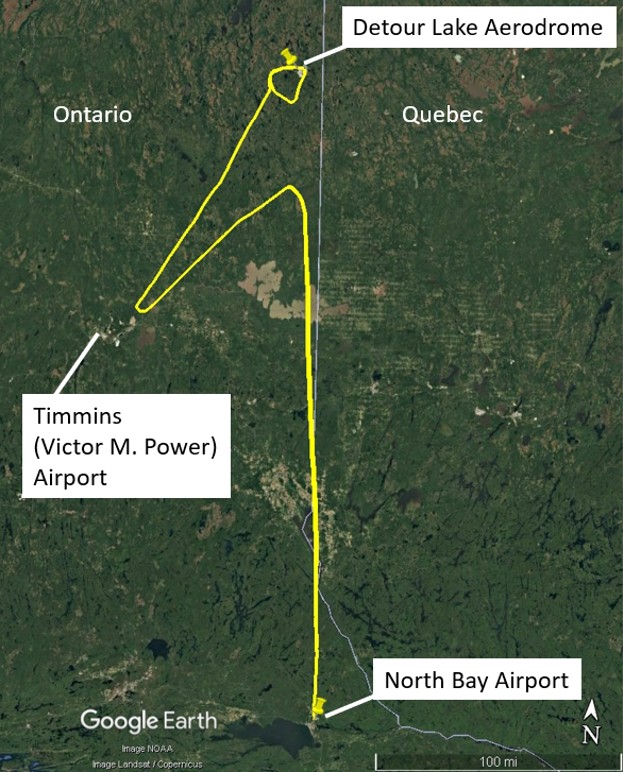
At 0922, wind information was obtained from the automated weather observation system (AWOS) based at CDT9, which indicated that winds were from 360° magnetic (M)The most recent magnetic variation for CDT9 was 12° west, measured in 2022. at 15 knots, gusting to 20 knots.
Based on a 100° crosswind and the direction of the aircraft, the captain, as the PF, briefed the area navigation approach using the global navigation satellite system (RNAV [GNSS]) Y for Runway 10Runway 10 is aligned on a magnetic heading of 103°. approach via the DUGRODUGRO is the initial GPS waypoint for the RNAV (GNSS) Y RWY 10 approach to CDT9. transition. The planned level of service was localizer performance with vertical guidance (LPV) (Appendix D).
With this approach, there are 3 different segments and a 3.6° glide path, which is intercepted at a minimum of 2300 feet ASL at the final approach waypoint (FAWP). The approach then has a 15° right turn to the final approach segment, with a distance of 3.4 NM.
On final approach, a higher descent rate is required (based on a ground speed of 140 knots, and a descent rate of 890 fpm with no wind) to reach a minimum descent altitude of 250 feet above ground level (AGL).
After the captain completed the approach briefing, the first officer noticed the ground speed was low and realized that the flaps had remained in the quarter position after the emergency descent. The flaps were then fully retracted.
On the approach, when the flight crew obtained visual contact with the runway, they realized that the aircraft was not aligned with the runway centreline. The first officer called for a missed approach.
The captain actioned the call and then flew the published missed-approach procedure, which calls for the aircraft to continue straight ahead (on the runway heading) to 1400 feet ASL and then turn right to a waypoint to the south, with a published holding procedure at 2500 feet ASL.
In the early part of the missed approach, ground support at the aerodrome radioed the flight crew and asked if they would be returning for a 2nd approach. The flight crew responded in the affirmative.
The first officer completed the after-takeoff checklist. The captain decided to conduct a pilot monitored approach (PMA)See Section 1.17.4.2 Pilot monitored approaches of this report for more information. because of the low ceiling (overcast at 300 feet). The first officer reactivated the RNAV (GNSS) Y RWY 10 approach using the DUGRO transition and re-briefed the approach. The flight crew did not complete the step in the SOPs that requires a PMA review. At this point, control of the aircraft was transferred to the first officer, who became the PF. The captain, who then became the PM, planned to take back control to land once the aircraft had reached the approach minima and the flight crew had obtained visual contact with the runway.
At 1004:26, when the aircraft was on the final segment of the 2nd approach (2.4 NM to 0.7 NM from the runway threshold), the rate of descent varied from 1000 to 2000 fpm and, simultaneously, a ground proximity warning system (GPWS) “sink rate” aural alert sounded. After receiving this alert, the PF reduced the aircraft’s rate of descent. The flight crew had briefed the approach speed, which was based on the landing weight. The planned approach speed was 140 knots indicated airspeed (KIAS), which would gradually be reduced to 115 KIAS to achieve the required landing reference speed (Vref) for touchdown.
At 1005:05, with the runway in sight, the captain took control of the aircraft and became the PF. He asked for flaps to be set to full. When the aircraft was 0.75 NM from the runway threshold, a “pull up” alert from the GPWS sounded. The aircraft’s descent rate was approximately 2000 fpm.
According to the AWOS, the winds at 1003 were from 340°M at 9 knots, gusting to 19 knots, with a variable direction from 300° to 360°.
At 1005:13, the aircraft was at 171 feet above the touchdown zone elevation (TDZE) and 0.5 NM from the runway threshold at a speed of approximately 150 KIAS.The flight data recorder calculates the airspeed data in knots calibrated airspeed, which takes into account any instrumentation and position errors. When an aircraft is travelling at slow speeds at low altitude, the difference between calibrated and indicated airspeeds is negligible. The difference can grow at higher speeds and altitudes.
At 1005:18, when the aircraft was at 98 feet above the TDZE, the flight data recorder (FDR) recorded a negative torque value, indicating that the engine was in reverse thrust (Appendix E). The first officer informed the captain that BETA was selected, which the captain acknowledged and, 1 second later, a positive torque value was recorded. A 2nd negative torque value was recorded on the right and left engines just before touchdown.
When the aircraft was at 11 feet above the TDZE, at 1005:25, the aircraft’s roll angle was recorded as 15.4° to the right, and the aircraft was in a nose-down attitude. As a result, the right wing impacted the runway (Figure 2), and the nose gear and right main landing gear collapsed. The right propeller was the 1st to contact the runway surface approximately 305 m (1000 feet) past the runway threshold.
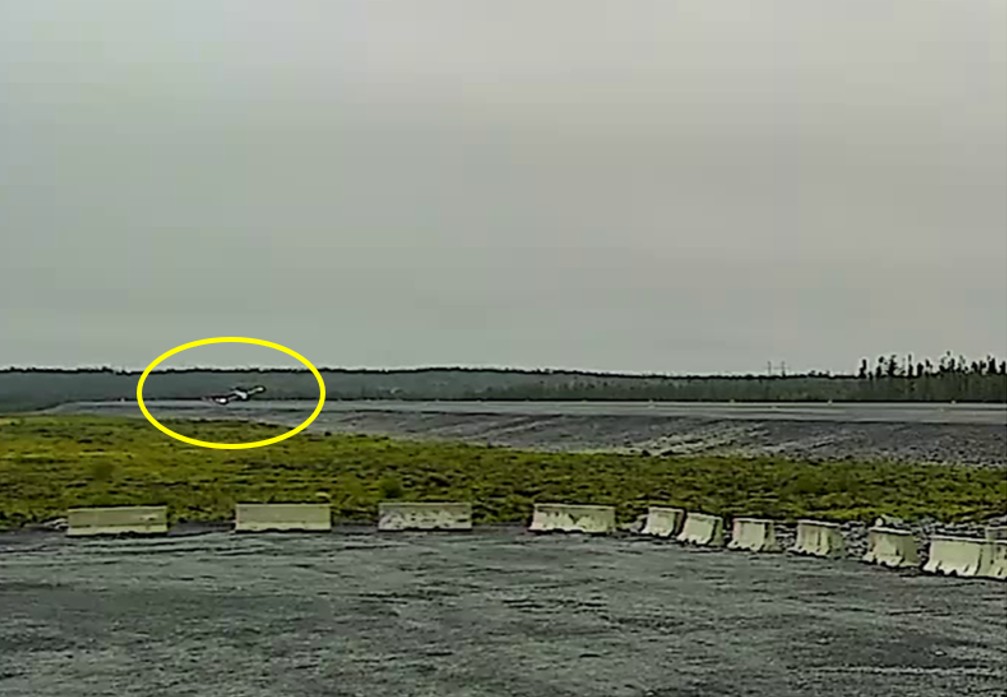
The aircraft veered to the right (south) of the runway centreline, leaving the runway surface laterally and sliding down an embankment. The left main landing gear collapsed, and the aircraft came to rest in an upright position approximately 47 m (154 feet) from the runway, facing south-southwest on a heading of 210°M (Figure 3).
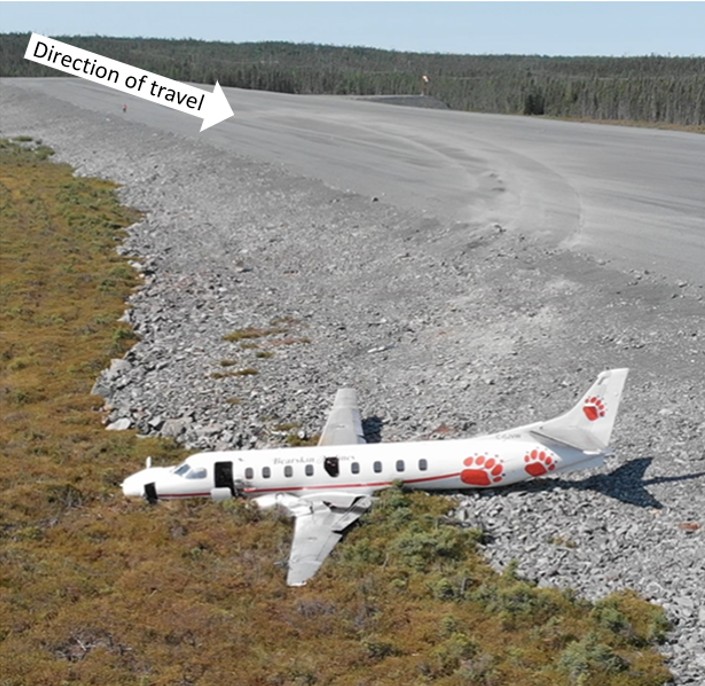
While the flight crew was conducting the emergency shutdown, the passengers, of their own volition, began egressing the aircraft through the main cabin door and the over-wing exits. The engines were still operating at the time.
When the first officer opened the main cabin door and realized that the engines were still operating, he returned to the cockpit and pulled the engine start/stop buttons to shut down the engines. Both flight crew members then egressed. Aerodrome ground service personnel responded within several minutes of the occurrence and, at 1019, Agnico Eagle Mines Limited’s volunteer firefighters and medical personnel responded.
The emergency locator transmitter (ELT) did not activate.
At 1014, Perimeter Aviation contacted a NAV CANADA air traffic operations specialist who then informed Toronto ACC that the aircraft had impacted the runway.
The aircraft was substantially damaged. Three passengers and 1 flight crew member received minor injuries.
1.2 Injuries to persons
There were 2 flight crew members and 8 passengers on board. Table 1 outlines the degree of injuries received.
Degree of injury | Crew | Passengers | Persons not on board the aircraft | Total by injury |
|---|---|---|---|---|
Fatal | 0 | 0 | – | 0 |
Serious | 0 | 0 | – | 0 |
Minor | 1 | 3 | – | 4 |
Total injured | 1 | 3 | – | 4 |
1.3 Damage to aircraft
The occurrence aircraft was substantially damaged during the accident sequence.
Neither the aircraft’s cabin nor cockpit was compromised. However, the fuselage’s underside was wrinkled and punctured at numerous places along its length, including the wing centre structure. The aircraft fuel tanks were damaged from the impact with loose rock off the side of the runway. The nose landing gear and the left main landing gear were completely detached, while the right main landing gear was displaced but remained attached.
Both propellers shed all composite blades and exhibited damage to each hub. Both engines received significant damage from ingesting runway surface material and propeller blade particles.
1.4 Other damage
Two runway edge lights and the surface of the gravel runway were damaged.
The fuel tanks were punctured, and an unknown amount of fuel spilled. The aerodrome owner deployed members of its environmental team to the scene, and they conducted a site survey/environmental assessment and initiated a clean-up plan.
1.5 Personnel information
Captain | First officer | |
|---|---|---|
Pilot licence | Airline transport pilot licence – aeroplane | Commercial pilot licence – aeroplane |
Medical expiry date | 01 February 2024 | 01 September 2024 |
Total flying hours | 2688 | 542.2 |
Flight hours on type | 658 | 282.9 |
Flight hours in the 24 hours before the occurrence | 6.1 | 6.1 |
Flight hours in the 7 days before the occurrence | 15.4 | 15.4 |
Flight hours in the 30 days before the occurrence | 63.5 | 49.4 |
Flight hours in the 90 days before the occurrence | 185 | 168 |
Flight hours on type in the 90 days before the occurrence | 185 | 168 |
Hours on duty before the occurrence | 3.75 | 3.75 |
Hours off duty before the work period | 15.6 | 15.6 |
The captain joined Perimeter Aviation in August 2022 as a first officer and completed upgrade training to become a captain on the Fairchild SA227 Metro 23 aircraft in March 2023.
The first officer joined Perimeter Aviation in April 2023 and completed initial training and a pilot proficiency check (PPC) on the Fairchild SA227 Metro 23 aircraft in April 2023.
When the captain and first officer were hired by Perimeter Aviation, they had no previous experience working for a Canadian Aviation Regulations (CARs) Subpart 703 (Air Taxi Operations) or Subpart 704 (Commuter Operations) operation. The flight crew held the appropriate licences and current medical certificates, in accordance with existing regulations.
1.6 Aircraft information
1.6.1 General
The Metro 23 is a pressurized twin turboprop aircraft with retractable landing gear. The occurrence aircraft was configured to carry 19 passengers.
Manufacturer | Fairchild Aircraft Incorporated* |
|---|---|
Type, model, and registration | SA227-DC Metro 23, C-GJVW |
Year of manufacture | 1995 |
Serial number | DC-872B |
Certificate of airworthiness issue date | 24 January 2018 |
Total airframe time | 32 893.4 hours |
Engine type (number of engines) | Garrett TPE331-12UHR-701 G (2) |
Propeller type (number of propellers) | MT-Propeller MTV-27-1-E-C-F-R (G) (2) |
Maximum allowable take-off weight | 16 500 lb (7500 kg) |
Recommended fuel type(s) | Jet A, Jet A-1, Jet B, JP-4, JP-5. JP-8 |
Fuel type used | Jet A |
* Ontic Engineering and Manufacturing Inc. currently holds the type certificate for the aircraft type.
There were no reported outstanding defects or known deficiencies with the aircraft up until the time of the occurrence flight.
1.6.1.1 Engines
The aircraft is powered by 2 Garrett turboprop engines. Each engine has a single spool with a 2-stage centrifugal compressor driven by a 3-stage axial-flow turbine, a single reverse-flow annular combustor, and an integral reduction gearbox that drives the aircraft propeller.
The engine is designed to run at a constant speed, and each engine is controlled by using a power lever and an rpm lever mounted side-by-side on the throttle quadrant in the cockpit (Figure 4).
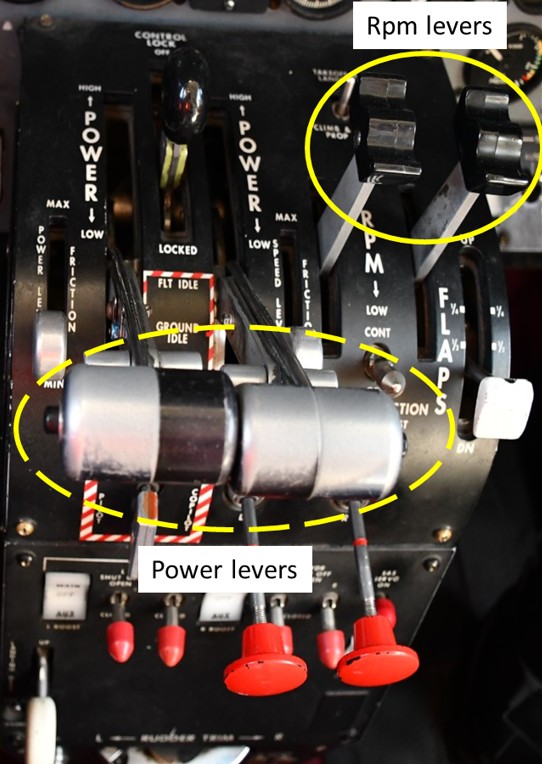
Engine speed is directly proportional to propeller speed (rpm) and displayed in the cockpit by a percent rpm gauge. Engine power, or torque, is displayed in the cockpit by a percent torque gauge. The gauges are located on the instrument panel, left of the throttle quadrant.
The power lever connects to the propeller pitch control and the manual fuel valve. The rpm lever connects to the propeller governor and to the under-speed fuel governor.
The power levers (Figure 4) control the torque by moving the fuel valve in the fuel control unit. The fuel valve adjusts the fuel flow (power) in direct response to the power lever position.
The power lever has 2 modes of operation. When the power lever is forward of the flight idle stop, the engine is in the propeller-governing mode; this mode maintains a constant rpm by varying the propeller blade angle in direct response to the movement of the power lever, which adjusts the fuel flow.
When the power lever is aft of the flight idle stop, the engine is in BETA mode. In BETA mode, the power lever varies the engine load by changing the propeller blade angle through the propeller pitch control. The engine’s rpm is maintained in response to the load by varying the fuel flow through the under-speed fuel governor in the fuel control unit.
The rpm lever incorporates a high- and low-rpm lever position that enables the flight crew to decrease the engine rpm, which can help reduce noise and improve fuel economy. The rpm depends on the positioning of the power lever in either of its 2 modes of operation.
For takeoff and landing, with the power lever forward of the flight idle stop in the propeller-governing mode, the rpm lever’s high position sets the propeller governor rpm at 100%.
During cruise, the rpm is set to 97%, per the aircraft flight manual (AFM). When the aircraft is on the ground and placed in BETA mode, with the power lever aft of the flight idle stop, the rpm lever’s low and high positions will set the rpm range of the under-speed fuel governor between 71% and 97%.
1.6.1.2 Propellers
The Metro 23 was originally equipped with two 4-bladed, constant-speed, full-feathering, reversible-pitch propellers. Both propellers operate at a constant speed with automatic synchrophasing.
The occurrence aircraft was equipped with 2 MT-Propeller 5-blade units that are hydraulically operated to vary blade pitch. The pitch change mechanism permits operation in constant-speed, feather, and reverse modes. Each propeller has a milled aluminum alloy hub, and each blade is composed of a wood internal core covered with composite fibre.
The propellers are single-acting units in which hydraulic pressure opposes the force of springs and counterweights in the hub to produce the correct pitch for a given engine load. Hydraulic pressure moves the blades toward low pitch, which increases the rpm. Springs and counterweights move the blades toward high pitch, which decreases the rpm. The source of the hydraulic pressure for operation is engine oil boosted by the governor gear pump.
1.6.1.3 Engine controls and BETA mode
When the power lever is brought aft of the flight idle stop, the engine is in BETA mode. This mode is used for ground manoeuvring operations and reverse thrust. In BETA mode, the power lever varies the propeller blade angle using the propeller pitch control to achieve reverse thrust.
The operation of the propellers in BETA mode during flight is prohibited by the manufacturer as noted in the Limitations section of the AFM, which states:
WARNING
- PROPELLOR REVERSING IN FLIGHT IS PROHIBITED
- DO NOT RETARD THE POWER LEVERS AFT OF THE FLIGHT IDLE GATE IN FLIGHT. SUCH POSITIONING MAY LEAD TO LOSS OF AIRPLANE CONTROL OR MAY RESULT IN AN ENGINE OVERSPEED CONDITION AND CONSEQUENT LOSS OF ENGINE POWER [emphasis in original]Fairchild Aircraft Incorporated, FAA Approved Airplane Flight Manual: Fairchild Aircraft Model SA227-DC, Revision 34 (09 December 2014), Section 1: Limitations, 6 DC propellor reversing, pp. 1-2.
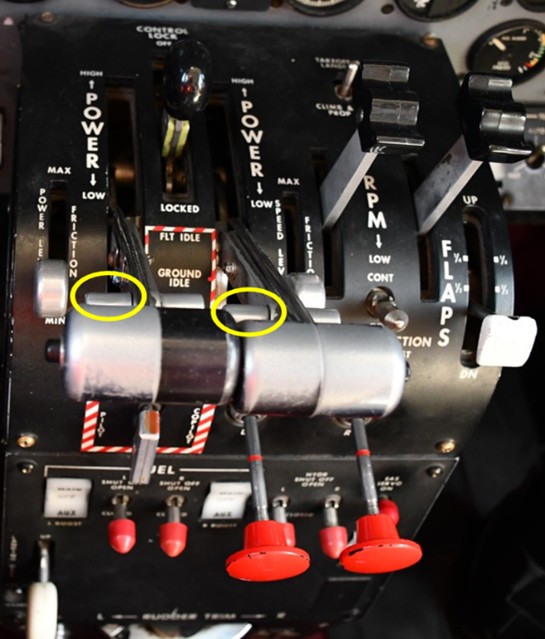
To ensure each power lever is not inadvertently moved aft of flight idle and, therefore, into BETA mode, there is a physical gate that stops the power lever lift latch arms. To enter BETA mode, the pilot must pull finger-lift knobs (Figure 5) upward against spring pressure. This action raises the lift latch arms, allowing them to clear the physical gates and permitting the power levers to be moved aft of the flight idle stop.
When the aircraft is in BETA mode, 2 amber lights (L BETA and R BETA) will illuminate on the annunciator panel located in the upper centre pedestal. There are also 2 secondary indications that the aircraft is in BETA mode: a change in engine parameters and a distinct change in engine/propeller sound.
Ireland’s Air Accident Investigation Unit highlighted the potential consequences related to placing an aircraft in BETA mode while in flight in its investigation report detailing an accident that involved a similar aircraft’s roll during a missed approach that took place in Cork, Ireland, in 2011.Air Accident Investigation Unit (AAIU)-Ireland, Formal Report: Accident: Fairchild Aircraft Corporation SA 227-BC METRO III, EC-ITP, Cork Airport, Ireland, 10 February 2011 (November 2014), at https://aaiu.ie/sites/default/files/report-attachments/REPORT%202014-001_0.pdf (last accessed on 03 June 2026).
1.6.1.4 Emergency locator transmitter
The aircraft was equipped with an Artex C406-1 ELT, which did not activate during the occurrence. The FDR captured a maximum vertical g value of 1.2g. However, it was directly followed by abnormal data points in all parameters, indicating a loss of a clean and valid signal.
It could not be determined what the actual maximum g value was at impact with the runway surface or throughout the accident sequence. Therefore, it cannot be stated with certainty that the g value experienced was sufficient to activate the ELT. Notwithstanding, the ELT and its related components were removed from the aircraft and sent to the TSB Engineering Laboratory in Ottawa for testing.
1.6.1.4.1 Emergency locator transmitter activation performance test
An ELT activation performance test was completed at the TSB Engineering Laboratory. The inertia switch was tested while still attached to the ELT circuit board. The switch was activated multiple times and was found to meet the parameters specified. No sign of obstruction or binding was detected during inertia sensor mass displacement. This confirmed that the ELT was functional as a stand-alone unit.
1.6.1.4.2 Emergency locator transmitter transmission testing with remote switch harness 12-pin male connector
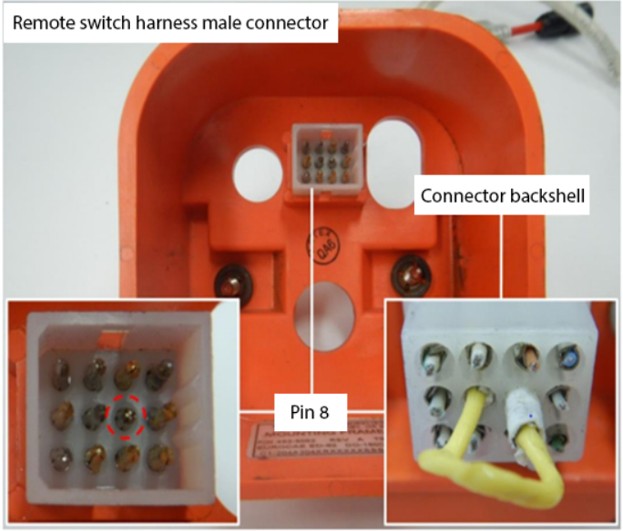
The ELT was then tested in conjunction with the remote switch harness 12-pin male connector. The ELT did not activate in this configuration during the activation performance test. It should be noted that this is how the unit was configured when installed in the aircraft. Visual inspection of the connector backshell of the remote switch harness revealed that Pin 8 was retracted from its normal position (Figure 6). Pin 8 was manually pushed back in place and the test reinitiated. The ELT activated and the performance test was positive.
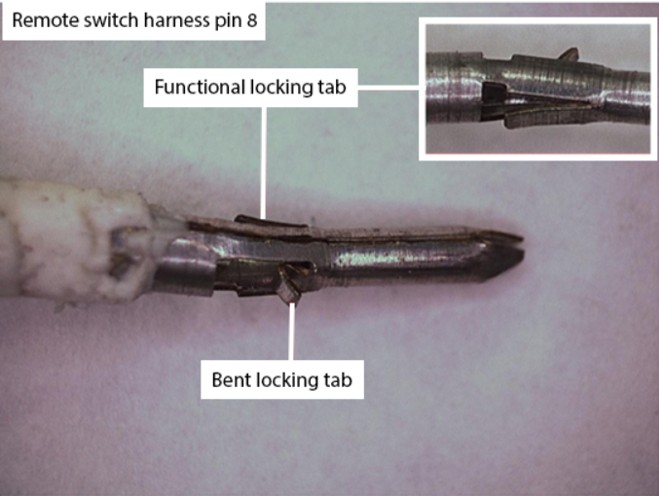
The locking pin mechanism of Pin 8 consisted of 2 locking tabs on opposite sides of the pin. One of the locking tabs was found bent forward. The other one was found functional. Pin 8 was also found deformed in a curved shape (Figure 7). The ELT manufacturer does not supply wiring or prefabricated switch harnesses for installation. Fabrication and installation of the switch harness was carried out by the airframe manufacturer or a maintenance organization. The investigation could not determine what caused the damage to Pin 8.
The ELT’s 15-digit hexcode found on the protective top cover assembly sticker was not the same hexcode obtained from the functional test carried out at the TSB Engineering Laboratory.Once an ELT is in service, it is the responsibility of the aircraft operator to ensure that the hexcode is accurate.
When maintenance is performed on an ELT, a decal noting the maintenance performed should be affixed to the ELT for traceability and as a reminder of the next maintenance due date. There was no such decal attached to the occurrence ELT.
1.6.1.5 Pressurization components
The investigation inspected key components of the pressurization system to determine their condition and function.
The cabin door seal was visually inspected and found mostly intact except for a tear that had resulted from impact damage during the accident sequence. As a result, the seal could not be inflated for testing. A detailed physical examination of the door seal revealed that the undamaged portion was unremarkable and that the seal should have been capable of functioning normally during the flight.
The cargo door seal was visually inspected and found to be intact with no impact damage visible. This seal was inflated with shop air and remained inflated with no leaks noted. Therefore, it would have been capable of functioning normally during the flight.
Both the cabin pressurization outflow valve and the cabin pressurization controller were removed from the aircraft and sent to the TSB Engineering Laboratory for inspection and testing.
The cabin pressurization outflow valve—the primary means by which cabin pressurization is controlled—was examined and found to be free of damage and defects. Additionally, manual manipulation of the rubber diaphragm/valve showed it to move freely with no binding. The sealing surfaces were damage free, and the diaphragm was observed to seal properly.
When the cabin pressurization controller was examined, it was noted that there were obvious gouges and scoring on the rate control knob shaft. Such gouges and scoring on the shaft may have been indicative of a slippage situation whereby the rate control knob moved on the shaft, resulting in the shaft not turning when the rate control knob was turned. This likely would have then initiated maintenance action to re-tighten the setscrew in a slightly different location.
When the flight crew attempted to adjust the cabin pressurization, there was no change. It is possible that a slipping rate control knob prevented the flight crew from being able to adjust the cabin pressurization rate during the flight. Such a situation would have necessitated the crew to resort to manual control of the cabin pressurization to maintain passenger and crew comfort.
It was not possible to conduct complete pressurization testing or troubleshoot the system owing to fuselage damage incurred during the accident.
1.7 Meteorological information
CDT9 has an automated weather observation system (AWOS), which broadcasts on a very high frequency (VHF) and provides weather data that is updated every minute.
The data includes wind direction and speed, visibility, ceiling, temperature, dew point, and the altimeter setting.
In the 7 AWOS reports preceding the occurrence, issued each minute from 1000 to 1006, the following weather data was provided:
- Winds were from 340° to 350°M at an average speed of 11 knots, gusting to 19 knots
- Visibility of 10 statute miles
- Overcast ceiling at 300 feet AGL (variable from 200 to 400 feet)
- Temperature 8 °C and dew point 8 °C
- Altimeter setting 29.92 inches of mercury
At 1003 and 1004, the reported wind was varying in direction from 300°M to 010°M.
At 1005, the time of the occurrence, the winds were from 350°M, which created a 100° left crosswind.
1.8 Aids to navigation
The Canada Air Pilot (CAP4) indicates that the following 4 RNAV approaches and 1 departure procedure are available at CDT9:
- RNAV (GNSS) Z RWY 10 (Level of service: lateral navigation [LNAV])
- RNAV (GNSS) Y RWY 10 (Level of service: LPV and LNAV) (Appendix D)
- RNAV (GNSS) Z RWY 28 (Level of service: LNAV)
- RNAV (GNSS) Y RWY 28 (Level of service: LPV and LNAV)
- GRAMP ONE DEP (RNAV departure procedure for Runway 10/28)
1.9 Communications
There were no known communication difficulties between air traffic control and the flight crew.
1.10 Aerodrome information
CDT9 has 1 gravel runway (Runway 10/28), which is 5002 feet long, 148 feet wide, and at an elevation of 953 feet ASL. The runway has type K aircraft radio control of aerodrome lighting (ARCAL)Page A83 of NAV CANADA’s Canada Flight Supplement (effective 26 December 2024 to 20 February 2025), General Section describes the use of type K ARCAL lighting: pilots can turn on all aerodrome lighting from the air for approximately 15 minutes. To do so, pilots will first key the aircraft’s microphone 7 times to set all lights to maximum intensity. Pilots can then adjust the intensity up or down to high, medium, or low intensity by keying the aircraft’s microphone 7, 5, or 3 times, respectively, within 5 seconds. high-intensity edge lighting and a P2 precision approach path indicator (PAPI)Page A87 of the same document specifies that a P2 precision approach path indicator (PAPI) is for aircraft with an eye-to-wheel height of up to 25 feet. on both ends.
There is a noise-sensitive wildlife habitat near the runway.
The investigation determined that runway conditions were not a factor in this occurrence.
1.11 Flight recorders
The aircraft was equipped with a solid state L3 Fairchild model F1000 FDR, which contained approximately 113 hours of flight data, including the occurrence flight. The FDR data was successfully downloaded at the TSB Engineering Laboratory.
The aircraft was also equipped with a cockpit voice recorder (CVR), which had a recording capacity of 120 minutes; its recorded data included the occurrence flight. The CVR data was successfully downloaded at the TSB Engineering Laboratory and contained good quality audio of the occurrence flight.
Both the FDR and CVR stopped recording at the time of contact with the runway.
1.12 Wreckage and impact information
The aircraft veered laterally off the south side of the runway and down an embankment that contained loose rock.
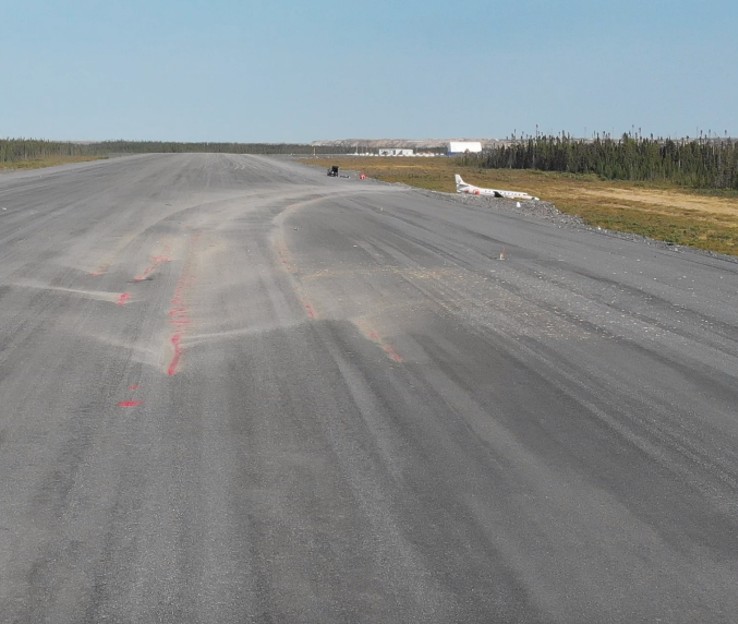
The 1st visible impact mark on the gravel runway was 307 m (1007 feet) from the threshold of Runway 10 and 5 m (15 feet) right of the runway centreline (Figure 8).
Both left and right propeller markings, which were approximately 60 m (197 feet) past the initial impact marks, consisted of wood fibres and wood splinters that covered a large section of the gravel runway.
Various components of the left and right main landing gears as well as debris from the nose wheel steering system were also found on the runway. The nose cone, right main landing gear, and the damaged edge lights were within 60 m (197 feet) of the aircraft’s final resting position.
The occurrence aircraft’s fuselage pressure vessel was punctured in multiple sections due to impact damage by the loose rock.
1.13 Medical and pathological information
There was no indication that the flight crew’s performance was negatively affected by medical or physiological factors, including fatigue.
1.14 Fire
There was no fire either before or after the occurrence.
1.15 Survival aspects
When the aircraft came to rest, both engines were still running and fuel was leaking from the aircraft. Although no fire occurred, the leaking fuel in the presence of the running engines presented a significant risk of fire.
Before waiting for a command from the flight crew, some passengers began evacuating through the over-wing exits. When the first officer opened the main cabin door, he realized that the engines were still operating. He then returned to the cockpit and pulled the engine start/stop buttons to shut down the engines.
Within several minutes, aerodrome ground service personnel responded and, approximately 10 minutes later, the Agnico Eagle Mines Limited’s volunteer fire department also responded, as did medical personnel.
1.16 Tests and research
1.16.1 TSB laboratory reports
The TSB completed the following laboratory reports in support of this investigation:
- LP127/2023 – FDR Recovery, Flight Reconstruction and Engine BETA Analysis
- LP128/2023 – CVR Data Recovery
- LP129/2023 – NVM [non-volatile memory] Recovery-GPS [global positioning system]
- LP143/2023 – ELT Analysis
- LP006/2024 – Cabin Pressurization Components Examination
1.17 Organizational and management information
1.17.1 General
Perimeter Aviation is a regional air operator providing scheduled, charter, and air ambulance services under CARs subparts 703 (Air Taxi Operations), 704 (Commuter Operations), and 705 (Airline Operations) to remote communities in Manitoba and northern Ontario. The occurrence flight was conducted under Subpart 703.
Perimeter Aviation is owned by Exchange Income Corporation, which acquired Bearskin Airlines in 2018. Although Bearskin Airlines is no longer a legal entity, Exchange Income Corporation chose to retain the Bearskin Airlines brand within the new larger airline (Perimeter Aviation).
Perimeter Aviation’s headquarters is located at Winnipeg/James Armstrong Richardson International Airport (CYWG), Manitoba. The operation is divided into 2 groups: eastern and western.
The eastern group has 3 sub-bases:
- Sioux Lookout Airport (CYXL)
- Thunder Bay Airport (CYQT)
- Timmins (Victor M. Power) Airport (CYTS)
The western group is made up of the headquarters and 1 sub-base, located at Thompson Airport (CYTH), Manitoba.
Perimeter Aviation operates a fleet of 43 aircraft, consisting of DHC-8 (Dash 8s) and Metro 23 aircraft (including CCs and DCs).
1.17.2 Supervision
Most of the flight operations management team is based in Winnipeg. Pilots are supervised by the chief pilot and 2 assistant chief pilots (1 for the eastern group and 1 for the western group). The chief pilot reports to the operations manager. The Metro 23 pilots report to the assistant chief pilot within their respective group.
1.17.3 Flight crew training
Flight crew training requirements are stipulated in sections 703.98 and 704.115 of the CARs and in sections 723.98 and 724.115 of the Commercial Air Service Standards (CASS).
At Perimeter Aviation, a learning management system is in place for flight crew training, which includes a combination of online learning, in-class learning, and practical training.
The guidance and curriculum for the training of Metro 23 pilots are provided in the Flight Crew Training Manual (FCTM).Perimeter Aviation LP, Flight Crew Training Manual (FCTM), Rev. 6 (01 December 2021). This manual provides generic training programs for its pilots, including Metro 23 and MerlinMerlin aircraft were initially produced by Swearingen, then later by Fairchild Aircraft. The Merlin is the predecessor to the Metro. generic training programs, and more specific programs for different aircraft types.
The Metro 23 and Merlin generic training program includes area navigation, gravel operations (for captains only), servicing and ground handling, emergency procedures, and line indoctrination (initial/transition).
The Metro 3 training program and the Metro 23 differences training program include elementary work, flight training, take-off minima with a reported runway visual range (RVR) of 1200 feet, technical ground training (initial and recurrent), and training forms.
The flight training program uses a combination of flight training devices (FTDs) and aircraft training. The FTD training incorporates a line-oriented flight training scenario from the operator’s safety management system (SMS) database to develop training lessons.
A cockpit procedures trainer is also used if there is no FTD available.
There are a range of training exercises to be completed using the company’s SOPs as guidance. These exercises include normal, abnormal, and emergency procedures and checklists.
The ground-based technical training provides specific training for the Metro 3 and includes an overview of the differences between the Metro 3 and the Metro 23 systems with respect to normal, abnormal, and emergency procedures.
1.17.3.1 Gravel operations
Section 704.51 of the CARs states the following with respect to taking off and landing on gravel runways:
(1) No air operator shall authorize a flight from or to a gravel runway in an aeroplane unless the company operations manual sets out procedures for take-offs and landings on gravel runways.
(2) No person shall conduct a take-off or landing in an aeroplane on a gravel runway unless the person has
(a) received ground training that includes the characteristics of take-off and landing surfaces, the conduct of obstacle assessments, and the air operator’s procedures for take-offs and landings on gravel runways;
(b) conducted, within the previous two years, at least one take-off and one landing on a gravel runway in an aeroplane of the same type as the one to be operated; and
(c) been certified by the chief pilot as being competent to conduct take-offs and landings on gravel runways.Transport Canada, SOR/96-433, Canadian Aviation Regulations, section 704.51.
Gravel operations training is outlined in Perimeter Aviation’s FCTM and company operations manual, as required. The training is included in initial training only and the minimum flight time allotted to the topic is 0.3 hours (18 minutes). To meet the CARs requirements, pilots must perform at least 1 takeoff and 1 landing every 2 years on a gravel runway.
The investigation determined that Perimeter Aviation informally emphasized the tendency for gravel runways to be shorterThe TSB reviewed the length of gravel runways at 20 aerodromes in Manitoba and northern Ontario. The average length was 3700 feet. than other types of runways, as well as the importance of considering shorter runway length when determining whether aggressive braking is needed upon landing. The training also covers the characteristics of take-off and landing surfaces, including reduced braking performance and increased accelerate-stop distances if a takeoff is rejected on a gravel runway, given the heavy braking and use of reverse thrust, which can cause damage to the propellers, engines, and fuselage from gravel and dust. The training does not include a specific requirement to conduct a briefing before landing on gravel runways.
As part of his upgrade training, the captain of the occurrence flight received training on gravel operations in March 2023. He performed 4% of his landings on gravel runways during his time as a captain. Based on the experience requirements in Perimeter Aviation’s SOPs,Perimeter Aviation LP, SA-227 Standard Operating Procedures: Policies and Procedures, Rev. 17 (21 April 2023), Section 4.22.1.2: First Officer Experience, p. 120. the first officer was not permitted to land on a gravel runway.
1.17.4 Standard operating procedures
Perimeter Aviation requires that all flight crew members be familiar with the contents of the SOP manual and that they apply the policies and procedures accordingly.
The manual contains instructions and information necessary for personnel to perform their duties safely as well as information pertaining to the CARs and CASS.
The SOP manual is intended to supplement existing regulations. It also incorporates industry best practices that can complement and strengthen the safety requirements found in the CARs.
1.17.4.1 Standard operating procedures—phraseology
The purpose of an SOP in the cockpit is to support workload management, improve communication, provide for improved error management, and create increased situational awareness while reducing distraction. SOPs often require verbal callouts for an action to be taken and then to confirm that the action has been carried out. SOPs are particularly helpful during critical phases of flight, such as during an approach. The preamble of the SOPs states that if a deviation from an SOP is required, the captain must brief the flight crew on the change.
1.17.4.2 Pilot monitored approaches
A PMA is a procedure that may be used while conducting an instrument approach. It can enhance situational awareness, improve safety margins, and reduce workload because each flight crew member’s duties are more clearly identified. The decision to use a PMA for either a precision approach or a non-precision approach will depend on the circumstances involved to effectively manoeuvre the aircraft for a successful landing, especially in conditions of low visibility and low ceilings.
A PMA begins with an approach briefing and a review of the verbal callouts expected from each flight crew member. The first officer will assume the role of pilot flying (PF) and the captain will be the pilot monitoring (PM), which frees the captain to monitor the aircraft state and position while on approach. When the aircraft reaches the decision point, the captain will decide to either take control of the aircraft and land if the runway becomes visual and the aircraft is in a position to land, or to conduct a missed approach if these conditions are not met.
This procedure is not frequently used at Perimeter Aviation and, when it is used, it is normally in poor weather conditions (low visibility and cloud ceilings). As a result, the flight crew’s workload may increase given the requirement to use standard phraseology, increase monitoring, and provide verbal coaching.
An analysis of flight crew’s communication, starting from the beginning of the 1st approach until the aircraft’s impact with the runway (approximately 16 minutes and 47 seconds later), identified that the flight crew made 243 verbal callouts during this period. The verbal callouts were operational, used standard phraseology, and were associated with the approach, the missed approach, and the return for the 2nd approach.
1.17.5 Stabilized approach and policies
Perimeter Aviation provides stabilized approach procedures in its SOPs and company operations manual, as is encouraged in Transport Canada’s (TC) Civil Aviation Safety Alert (CASA) No. 2015-04, which states the following:
An approach is considered stabilized when it satisfies the associated conditions typically defined by an air operator in their Company Operations Manual or Standard Operating Procedures (SOP), as they may possibly relate to:
- Range of speeds specific to the aircraft type;
- Power setting(s) specific to the aircraft type;
- Range of attitudes specific to the aircraft type;
- Configuration(s) specific to the aircraft type;
- Crossing altitude deviation tolerances;
- Sink rate; and,
- Completion of checklists and flight crew briefings.
Stabilized approach criteria should be defined for all approaches and should include that:
- Approaches be stabilized by no lower than 1,000 feet (ft) above aerodrome elevation (AAE) when in instrument meteorological conditions (IMC);
- All approaches be stabilized by no lower than 500 ft AAE in visual meteorological conditions (VMC);
- A call be made upon reaching 1000 ft AAE in IMC or 500 ft AAE in VMC as to whether the approach is stabilized or not;
- The approach remains stabilized until landing;
- If an approach is not stabilized in accordance with these requirements, or has become destabilized afterwards, a go-around is required.Transport Canada, Civil Aviation Safety Alert (CASA) No. 2015-04: Stabilized Approach, Issue 02 (05 August 2019), pp. 2–3.
The CASA recommends that all certificate holders include a “stable” or “unstable” call at the appropriate gate or decision point at specified altitudes (e.g., at 1000 feet in IMC or 500 feet in VMC). Non-punitive go-around policies are also encouraged. Some operators employ a “should” gate ahead of the eventual harder decision gate, where the aircraft must meet all the criteria specified in the SOPs. Flight crews will do a preliminary check at the “should” gate and have the opportunity to correct any parameters that exceed the criteria, whereas when they reach the “must” gate, they must conduct a go-around if there are any exceedances from the criteria.
A review of the pilot training files indicated that both flight crew members had received Perimeter Aviation’s FCTM stable constant descent angle training. The SOPs provide guidance and state specifically the stabilized approach criteria during visual flight rules (VFR) and IFR conditions; however, there is no training syllabus that is specific to stabilized approach criteria and awareness.
1.17.5.1 Stabilized approach criteria
Section 4.20 of Perimeter Aviation’s SOPs states that a stabilized approach “requires that the aircraft be in the landing configuration and proper airspeed and sink rate by 500 feet AGL. Approach procedures must be standardized and consistent with existing conditions.”Perimeter Aviation LP, SA-227 Standard Operating Procedures: Policies and Procedures, Rev. 17 (21 April 2023), Section 4.20: Stabilized Approach Factors, p. 117. It also states the following:
Note: [emphasis in original] Any deviation from the following criteria must result in a missed approach and an SMS Report submitted within 24 hours for statistical tracking.
VFR Arrival: [emphasis in original] The aircraft shall be in a landing configuration and at an airspeed target of 140 kts [knots]. No later than 1000 AGL.
IFR Arrival: [emphasis in original] The aircraft shall be in a landing configuration and at an airspeed target of 140 kts [knots] no later than 1000 AGL.Ibid.
In addition, the SOPs state the following universally accepted approach criteria used by industry:
- The aircraft is on the correct flight path. Example: descent should be on the glideslope (or PAPI/VASI [visual approach slope indicator]/FPA [flight path angle]) to touch down;
- Only small changes in heading/pitch are necessary to maintain the correct flight path
- Final Approach Speed: Normally maintain 140 knots to then gradually reduce to approach speed to achieve VREF [landing reference speed] at touchdown;
- The aircraft is in the correct landing configuration
- Sink rate is no greater than 1000 feet/minute; if an approach requires a sink rate greater than 1000 feet/minute a special briefing should be conducted.
- Power setting is appropriate for the aircraft configuration and is not below the minimum power for the approach as defined by the operating manual.
- Approach Flap: ½ or Flap Full depending on landing distance available, ¼ Flap for an engine inoperative [emphasis in original];
- Landing Flap: Full for normal 2 engine landing, ¼, ½ Flap or Flap Full for an inoperative engine depending on landing distance available [emphasis in original].Ibid, pp. 117-118.
1.17.5.2 Unstable approach criteria in instrument meteorological conditions
Section 4.21 of Perimeter Aviation’s SOPs provides the following instruction with respect to unstable approaches:
- Where an approach deteriorates to the applicable criteria outlined in this section during normal operation, crews shall initiate a go-around.
- Either pilot shall call “Go-around” [emphasis in original] upon observing unstable criteria and shall not be challenged by the other pilot.Ibid., Section 4.21: Unstable Approach, p. 118.
Furthermore, Section 4.21.2 of Perimeter Aviation’s SOPs provides the following guidance on unstable approach criteria in IMC:
- Past the FAF [final approach fix], (or intercepting final approach course where there is no FAF):
- The aircraft fails to remain in normal position for landing with large changes in heading/pitch required to re-achieve the correct flight path;
- The aircraft is not configured with gear down, and flaps at least ½;
- The power setting is inappropriate for the conditions;
- The airspeed deteriorates to less than 130 knots before landing assured;
- The sink rate exceeds 1,000 FPM;
- Course deviations reach full scale deflection or 10°.Ibid., Section 4.21.2: Unstable Approach Criteria in IMC, p. 118.
1.17.6 Non-standard approaches: Detour Lake Aerodrome
Agnico Eagle Mines Limited had an independent contractor design the RNAV approaches, which were approved by TC and published in the Canada Air Pilot (CAP4) in February 2023.
The approach design enables RNAV/GNSS navigation to be used with LNAV and LPV approaches.
The RNAV (GNSS) Y RWY 10 (Appendix D) approach was identified as a non-standard approach by Perimeter Aviation when compared to standard T-shape approaches with straight inbound tracks to the runway. The approach was designed with 3 segments to avoid a noise-sensitive (wildlife) area near the aerodrome.
The segment to the final approach waypoint (FAWP) is offset by 18° from the runway heading of 103°. After crossing the FAWP, the aircraft turns 15° to the right and the approach with the level of service for LPV provides a 3.6° vertical guidance/glide pathThe standard glide path is 3.0°. to a height of 250 feet AGL, or 1203 feet ASL.
1.17.7 Safety management system
Air operators may hold air operator certificates for more than one subpart of the CARs. Even though an SMS is not required for all subparts, those air operators who are required to have an SMS for any part of their operation are encouraged by TC to have all parts of their operation comply with their SMS.
Perimeter Aviation has a TC-approved SMS in accordance with section 705.151 of the CARs for its airline operations and section 573.02 of the CARs for its approved maintenance organization (AMO). SMS information is distributed in both electronic and printed format to employees.
Perimeter Aviation’s SMS database is managed by its SMS manager. The database is used to identify, categorize, assess, and distribute SMS information to the appropriate parties.
Perimeter Aviation provides SMS training to all employees when they are initially hired and every 3 years thereafter. This training consists of an online course and exam.
Perimeter Aviation’s SMS manual includes a risk assessment policy, which involves analyzing and assessing all hazards based on established criteria that are described in its risk assessment guide. When no potential or known hazards exist, the overall assessment is classified as operational.
When an assessment is being evaluated, the appropriate manager is assigned to provide a report to the SMS manager.
1.17.7.1 Safety oversight and risk management
Perimeter Aviation’s SMS manual provides an overview of, and guidance on, risk management, with an organized process to analyze current and future operational changes and their impact on safety. Hazard identification is part of this process, enabling the mitigation of risk.
Section 4.4 of the SMS manual provides information on hazard identification contained in a range of company reports. The reports relate to safety, occupational health and safety, and operational issues.
Potential hazards are identified in a registry and ranked in the SMS database, which also provides an individual risk profile to assist with the evaluation.
1.17.8 Timeline of operational changes at Detour Lake Aerodrome
In August 2021, Perimeter Aviation initiated an SMS Quality Issue reviewPerimeter Aviation LP, Quality Issue: Establish Timmins, Ontario base infrastructure in support of Scheduled Charter DHC 8 flight and maintenance operations utilizing two (2) aircraft (created on 03 August 2021; closed on 29 March 2022). due to a planned operational change that would establish a sub-base at CYTS to support charter operations. The charter operations would include flights to CDT9.
Personnel and equipment requirements were reviewed, as well as potential hazards. Based on the company’s risk assessment guide, the general risk in flying to CDT9 was classified as low and was considered acceptable without any further action.
The review was primarily focused on logistical planning for flight operations, maintenance, ground support, and operational control and included an assessment of the aerodrome itself. The review noted that there was the potential for the proposed sub-base to risk the company’s reputation if logistical issues were not addressed.
A contract between Agnico Eagle Mines Limited and Perimeter Aviation was initiated in March 2022. The Dash 8 was the sole aircraft type to be used for the weekly charter flight to CDT9, with restrictions based on the weather (ceilings) because there were no approved or published instrument approaches to the aerodrome at that time.
As a contingency, motorcoaches would be used to transport passengers from CYTS to the mine on days when there were weather restrictions at CDT9.
In February 2023, IFR approaches were published for CDT9. When the approaches were approved, Perimeter Aviation acknowledged that, although still within the bounds of acceptable IFR approaches, the approaches did contain features that were uncommon to its flight crews.
Dash 8 pilots were asked informally by Perimeter Aviation’s senior management whether there were any issues flying these new IFR approaches. The Dash 8 pilots expressed no concerns; however, they were flying aircraft that had automation features, such as autopilot and en route VNAV, that helped manage some of the IFR approaches’ more challenging aspects.
In March 2023, the mining company requested that Perimeter Aviation operate an additional regular flight for 7 to 9 passengers from CYYZ to CDT9, with stops en route. Perimeter Aviation accommodated this request by using its Metro 23 aircraft.
The Metro 23 aircraft used for these charters were not equipped with automation features such as an autopilot or en route VNAV to assist flight crews and help reduce their workload. In addition, because Perimeter Aviation considered piloting the Metro 23 to be an entry-level position, its Metro 23 flight crews often had less experience. In general, the goal for newly hired pilots was to gain enough experience and seniority to eventually fly the larger Dash 8 aircraft.
In May 2023, soon after the operational change at CDT9, an experienced Bearskin Airlines pilot flew a Metro 23 aircraft to the aerodrome on a scheduled IFR flight. The pilot encountered IMC when he arrived and subsequently conducted a missed approach due to the conditions and approach features. He landed successfully on his 2nd attempt.
The pilot believed that this was not an unexpected outcome when flying a non-standard approach for the 1st time and in challenging weather conditions, and that the proper response—to conduct a go-around—was appropriate. Therefore, he did not share any information about the challenges encountered during this flight with the company operations team, nor was he required to.
1.17.9 Flight crew experience
In recent years, a shortage of pilots has been reported as a significant issue by air operators across the aviation industry. This shortage is having a considerable impact on the ability of air operators to meet their operational requirements,CBC News, “National pilot shortage poses challenge for small northern airline” (17 September 2023), at https://www.cbc.ca/news/canada/sudbury/pilot-shortage-northern-ontario-1.6966469 (last accessed on 05 June 2026).,CTV News, “Attracting, retaining pilots an ongoing issue in Canada: industry analysts” (06 February 2023), at https://www.ctvnews.ca/business/article/attracting-retaining-pilots-an-ongoing-issue-in-canada-industry-analysts/ (last accessed on 05 June 2026).,L. Gordon, “‘Enough is enough’: Canadian pilots weigh in on the shortage, wages, and FDT regulations” (31 May 2023), at https://skiesmag.com/news/canadian-pilots-think-shortage-fdt-regulations/#:~:text=Media-,%E2%80%99Enough%20is%20enough%E2%80%99'Enough%20is%20enough'%3A%20Canadian%20pilots%20weigh%20in%20on%20the,shortage%2C%20wages%2C%20and%20FDT%20regulations&text=For%20too%20long%2C%20the%20Canadian,and%20smell%20the%20Jet%2DA (last accessed on 05 June 2026). which forces air operators to increase their risk exposure by having to rely more on inexperienced pilots to ensure they remain commercially viable. The availability of qualified personnel was also identified as a safety theme in the TSB’s Air Transportation Safety Issue Investigation (SII) Report A15H0001.TSB Air Transportation Safety Issue Investigation Report (SII) A15H0001, Raising the bar on safety: Reducing the risks associated with air-taxi operations in Canada (07 November 2019), at www.tsb.gc.ca/eng/rapports-reports/aviation/etudes-studies/a15h0001/a15h0001.html (last accessed on 05 June 2026).
In 2017, Perimeter Aviation began noting an increase in the number of its first officers that were leaving the company before becoming captains compared to the company’s historical attrition rate.
Following the COVID-19 global pandemic, the company noted an increase in the number of pilots who failed their initial training and who struggled with their recurrent training. It also noted that some of its pilots were demonstrating gaps in the basic airmanship skills and knowledge normally acquired during training for a commercial pilot licence.
Following an aft fuselage strike on landing, which took place on 19 October 2022 at Sandy Lake AirportTSB Air Transportation Safety Investigation Report A22C0093. and involved a Perimeter Aviation flight crew flying a Dash 8 aircraft, the TSB investigation found that crew inexperience was a factor in the incident.
This example highlights that flight crew inexperience is also broader than just pilots flying commercially with relatively limited total flying hours. It can also represent pilots with higher total flying hours being recruited from other sectors of the aviation industry but lacking experience in their new operation, as was the case for the flight crew in that occurrence.
In the current occurrence, the flight crew members had relatively limited experience in their respective roles as captain and first officer, as evidenced by their flight hours on the aircraft type as well as this being their first job flying in a commercial operation.
In addition, the captain had not flown in weather conditions that approached minima for several months and had flown to CDT9 on only 2 previous occasions. On both of those flights, the weather conditions were favourable, and the captain was able to conduct a VFR approach, meaning he was not exposed to the IFR approach and its non-standard features. The first officer had flown into CDT9 once before. The weather conditions at the time were also favourable for VFR flight.
Also, the flight crew had limited experience landing on gravel runways.
In general, the primary mitigations employed by air operators, including Perimeter Aviation, to manage the shortage of qualified pilots consist of new approaches to training and building competency, as well as developing clearer and less ambiguous SOPs. It is difficult to measure the success of these mitigations in reducing the risk associated with flight crew inexperience.
TC is aware of the issue regarding flight crew inexperience. However, as is the case for air operators, TC finds the issue difficult to quantify and track given its multi-faceted nature and not enough clear data with which to objectively measure its impact on air operations.
1.18 Additional information
1.18.1 Regulatory oversight
TC conducted a reactive inspectionSection 6.3: Reactive surveillance of Transport Canada’s, Staff Instruction (SI), SUR-001: Surveillance Procedures, Issue 09 (04 August 2020) specifies that a reactive inspection is a tool the regulator can use to identify and obtain specific information either following an occurrence or for other reasons. 3 days after the occurrence flight. Interviews with flight crew members were conducted, and company manuals and publications, training records, and flight duty times were reviewed. The inspection determined that Perimeter Aviation was in compliance with existing regulations and no issues were reported.
1.18.2 Human factors issues
1.18.2.1 Workload
Workload describes the demands of one or more tasks being performed given the limited mental resources of the average person.S. Loft, P. Sanderson, A. Neal, et al., “Modeling and Predicting Mental Workload in En Route Air Traffic Control: Critical Review and Broader Implications,” in Human Factors, Vol. 49, No. 3 (June 2007), pp. 376-399.
When workload is low to moderate and there is a significant amount of mental resource capacity available, human performance tends to remain high; however, when workload is high and the demands of the task(s) exceed a person’s finite amount of mental resource capacity, performance begins to decline.
High workload occurs when a person is trying to manage too many tasks at once, or if a single task increases in difficulty to the point where the person’s performance begins to suffer either with that task or with secondary tasks.C. D. Wickens, W. S. Helton, J. G. Hollands, et al., Engineering Psychology and Human Performance (2022). pp. 477-479.
An increase in workload can be caused by various factors, including a person’s level of experience. For example, novices will typically report experiencing higher workload than experts when performing the same task.O. Tolvanen, A.P. Elomaa, M. Itkonen, et al., “Eye-Tracking Indicators of Workload in Surgery: A Systematic Review,” in Journal of Investigative Surgery, Vol. 35, Issue 6 (17 January 2022), p. 1340.
1.18.2.2 Expectancy in relation to action selection
A variety of factors influence a person’s response time. One of these factors relates to our expectancy regarding the triggering stimulus. In most stimulus-response situations, our expectancy helps to prepare us to respond quickly once the stimulus has been perceived.C. D. Wickens, W. S. Helton, J. G. Hollands, et al., Engineering Psychology and Human Performance (2022), p. 392. This is important to ensure as speedy a response as possible, especially in time-critical situations. The longer a person waits for a stimulus that they know is coming, the greater the anticipation as they prepare to engage their response when the time is right.
There is a downside to this anticipation, however, in that it can lead to inadvertent early activation of the desired response.
An example of this is a sprinter’s false start. When sprinters are waiting for the starting gun to go off, they are anticipating the sound of the shot. As a result, they build up a tremendous expectancy regarding that signal because they want to start the race as quickly as possible.
However, on occasion, sprinters will start their sprint too soon, resulting in a false start. This happens when the sprinters are unable to hold back their response to the stimulus, and they inadvertently trigger their response before hearing the shot.
1.18.2.3 Skill-based performance
There are 3 general ways to classify human performance from an information-processing perspective: skill-, rule-, and knowledge-based performance.J. Rasmussen, “Skills, Rules, and Knowledge; Signals, Signs and Symbols, and Other Distinctions in Human Performance Models,” in IEEE Transactions on Systems, Man, and Cybernetics, Vol. SMC-13, No. 3 (May/June 1983), pp. 257-266. Skill-based performance is observed in familiar situations and tasks that require very little attention to perform.
Typically, these tasks are relatively routine, predictable, and highly practised. Typing on a keyboard or transcribing information from a reference document to a written instruction could fall into such a level of performance. This level of performance is not chosen; rather it becomes, or is already, automatic.
The benefit of skill-based performance is that it can be very fast and requires relatively little attentional resources compared to other classes of performance. This frees up information-processing resources for other things. However, in a high-workload environment, where attentional resources may be taxed, this automatic performance is susceptible to slips and lapses.
1.18.2.4 Negative transfer of training
Transfer of training is defined as “[w]hat is learned in one set of circumstances can be used or applied to another situation.”E. Seedhouse, A. Brickhouse, K. Szathmary, et al., Human Factors in Air Transport: Understanding Behavior and Performance in Aviation (2020). p. 137. In some cases, however, this impact is not always positive. The transfer may be neutral (no impact) or negative.
Negative transfer refers to “when two situations have similar (or identical) stimulus elements, but different [emphasis in original] response or strategic components […].”C. D. Wickens, W. S. Helton, J. G. Hollands, et al., Engineering Psychology and Human Performance (2022), p. 302. Negative transfer constitutes a risk because the training can lead to faulty or inappropriate decisions or operational actions.
1.18.2.5 Plan continuation bias
Plan continuation bias is the tendency to continue an original plan of action even when changing circumstances necessitate a new plan.B. A. Berman and R. K. Dismukes, “Pressing the approach” in Aviation Safety World, Volume 1, Issue 6 (December 2006), p. 28.,S. Dekker, Safety Differently: Human Factors for a New Era, 2nd edition (CRC Press, 2014), p. 75.,J. Orasanu and L. Martin, “Errors in Aviation Decision Making: A Factor in Accidents and Incidents,” paper presented at HESSD 98, Working Conference on Human Error, Safety and Systems Development, Seattle, Washington (1998), p. 102. Once a plan is made and committed to, it becomes more difficult for cues or conditions in the environment to be recognized as indicating a need for change than if there had been no plan at all.
For people to recognize and act on a reason to change their plan in a timely manner (e.g., a pilot identifying the need to divert to an alternate landing site), conditions need to be perceived as sufficiently salient to require immediate action.
Most important for the continuation of plans (or for the abandonment of them for an alternative) are the contextual factors that surround people at the time. Two key aspects are the order in which cues about a developing situation arrive and their relative influence.S. Dekker, Safety Differently: Human Factors for a New Era, 2nd edition (CRC Press, 2014), p. 75. Situational cues and conditions often deteriorate gradually and ambiguously, not quickly and obviously.
With this gradual deterioration of conditions, there are almost always initial cues that indicate the situation is being managed and can be continued without an increase in risk level.Ibid., pp. 75-76. This helps lock people into continuing with the plan. Often, the consequences of abandoning a plan are serious (e.g., diverting a flight, conducting a missed approach), and a person requires strong evidence to change it.
Research shows that, as goal achievement gets closer (e.g., getting closer to a destination), there may be a natural tendency to downplay potential risk in favour of goal completion (i.e., reaching the destination).J.M. Orasanu, et al. “Errors in Aviation Decision Making: Bad Decisions or Bad Luck?,” paper presented at the Fourth Conference on Naturalistic Decision Making (May 1998), p. 8.
Human performance is goal-oriented and this is often a very positive aspect. However, for example, the combination of underestimating risks and being goal-oriented can contribute to a tendency for pilots to continue flight in marginal weather conditions, particularly if the consequences of choosing the alternative (e.g., delaying passengers) are high.
Research has been conducted into mitigations for ambiguous and uncertain situations in which pilots tend to continue with original plans. One mitigation suggests that risk management training should teach pilots to move beyond their initial risk assessment of the situation and look for alternative views, especially when their initial risk assessment conclusion is to continue the flight.J. Orasanu, U. Fischer, and J. Davison, “Risk Perception and Risk Management in Aviation,” in: Rainer Dietrich and Kateri Jochum (eds.), Teaming Up: Components of Safety under High Risk (Routledge, 2004), pp. 93-116, in R. Key Dismukes, Human Error in Aviation, Critical Essays on Human Factors in Aviation series (2009), p. 270.
Another mitigation for this type of situation is to change a company’s and pilots’ goal-oriented mindset from a default of continue flying, to the opposite—discontinue flying—when facing uncertain conditions with ambiguous cues. The purpose of this mitigation is to shift the decision making to one that can adequately assess the safety benefits or risks of either maintaining or modifying the original plan.Ibid.
A 3rd mitigation strategy is for pilots to consider how the company’s norms, values, goals, and reward system influence their own operational decision making. This is important because pilots often share the goals of the company, and there are often inherent goal conflicts present in normal, everyday operations.Ibid.
1.18.2.6 Experience and naturalistic decision making
Naturalistic decision making refers to how decisions are made in time-sensitive, dynamic, real-world settings. This accounts for human cognitive limitations and is characterized by making decisions in routine, nonanalytical ways, comparing actions in terms of expected value or utility. Experts, such as pilots, operating in time-sensitive and dynamic contexts apply naturalistic decision-making strategies depending on their experience, the task, and the operational context.M.R. Lehto and G. Nanda, “Decision-Making Models, Decision Support, and Problem Solving,” in: G. Salvendy and W. Karwowski (Ed.), Handbook of Human Factors and Ergonomics, 5th edition (John Wiley & Sons, 2021), p. 176. Experience plays a significant role in successful outcomes when making decisions in these types of settings.G. Klein, Sources of Power: How People Make Decisions (MIT Press, 1999), pp. 147–175, and 273–275. More specifically,
[b]ecause of their experience, experts have learned to see all kinds of things that are invisible to others. That is why they can move freely in their domain while novices must pick their way carefully through the same terrain.Ibid., p. 148.
This is primarily due to 2 key processes: pattern matching and mental simulation. Pattern matching refers to
the ability of the expert to detect typicality and to notice events that did not happen [but should have happened] and other anomalies that violate the pattern. Mental simulation covers the ability to see events that happened previously and events that are likely to happen in the future.Ibid., p. 149.
Those with significant experience understand the goals and priorities, as well as which cues are important, what comes next, and typical ways to respond in given situations. This type of decision making is efficient and performed quickly.
However, it is also susceptible to 3 categories of problems: inadequate experience in the decision maker, insufficient information in the unfolding situation, and a tendency on the decision maker’s part to find a reason to dismiss a cue or piece of information.Ibid., pp. 274–275. Furthermore, stressors such as time pressure, noise, and ambiguity have been shown to reduce the information people can consider when making decisions.Ibid., pp. 275–276.
To build expertise and become an effective decision maker, people need significant real-world training and experience.
1.18.2.7 Organizational drift
Research on system safety has identified that accidents are usually the result of a confluence of factors, which may include slips or lapses on the part of a person, while also being influenced by organizational behaviour.S. Dekker, Drift into Failure: From Hunting Broken Components to Understanding Complex Systems (2011), pp. 14–22.
One of the organizational patterns in complex systems is the potential to drift into failure. This occurs when components of these complex systems interact, evolve, and adapt to new situations in ways that cause operations to drift into the safety margin, often because of a scarcity of resources.
Because this drift is gradual or incremental, it is not easily identifiable. As well, there is a tendency for the drift in organizational performance to be judged by the success of the most recent change and not its distance from the original design.Ibid.
1.18.3 Hazard identification
Hazard identification is defined as
[i]dentifying the potential causes of accidents that have not yet occurred, in order to prevent them or, if that is not possible or feasible, to reduce the losses if they do occur.N. G., Leveson, Shortcomings of the Bow Tie and Other Safety Tools Based on Linear Causality (2019), at http://sunnyday.mit.edu/Bow-tie-final.pdf (last accessed on 09 June 2026).
Traditionally, hazard identification techniques, such as fault tree analysis or failure modes and effects analysis, among others, are based on a linear model of accident causality where 1 event leads to the next, with each event being dependent on the preceding event until it results in an accident.
This approach to determining accident causality is best understood by the concept of analytical decomposition: if you break up a more complex system into its component pieces and analyze each component in isolation, you will end up with an understanding of how those components will function when you put the system back together.N. G. Leveson, and J. P. Thomas, STPA Handbook (March 2018) at https://psas.scripts.mit.edu/home/get_file.php?name=STPA_handbook.pdf (last accessed on 09 June 2026).
The assumption is that these components will interact in direct and known ways, while looking at these parts in isolation will allow us to understand how they will function in the context of the system as a whole.
Although this assumption may have been true for the types of systems these models were originally developed to analyze, systems today—such as transportation systems—are significantly more complex and interconnected:
It is much more difficult today to anticipate, understand, plan, and guard against all potential system behavior before operational use of our systems. Complexity is creating “unknowns” that cannot be identified by breaking the system behavior into chains of events. In addition, complexity is leading to important system properties (such as safety) not being related to the behavior of individual system components but rather to the interactions among the components. Accidents can occur due to unsafe interactions among components that have not failed and, in fact, satisfy their requirements.Ibid., p. 7.
Operations in complex systems, such as in commercial air transport, contain a multitude of different dimensions, such as crew factors, aircraft characteristics, weather, and traffic. Each of these dimensions can pose a hazard to the operation depending on the state it is in at a given point in time, given that these dimensions are dynamic, not static. Weather conditions, for example, exist along a spectrum from calm wind and clear skies to strong winds and low visibility. The weather conditions at a given time will determine if they are treated as a hazard.
However, because these dimensions are part of a complex system, they do not remain isolated from each other. They interact, and thus risk becomes cumulative across the various dimensions within a particular operation. This is what can be described as a multi-dimensional hazard, where the risk posed by this hazard is dependent on the state of each dimension and their potential for interaction in a given situation.
For example, if a pilot conducting a flight is managing fatigue, marginal weather conditions, and an aircraft with no automated features, it is possible that all of these aspects of the operation are near, but within, their individual prescribed limits. However, the cumulative operational risk is much higher than the assessment of each individual dimension given the risk of these does not remain isolated from each other, but in fact interacts in unexpected and potentially hazardous ways.
1.18.4 Operational pressures
In its SII Report A15H0001,TSB Air Transportation Safety Issue Investigation Report (SII) A15H0001, Raising the bar on safety: Reducing the risks associated with air-taxi operations in Canada (07 November 2019), at www.tsb.gc.ca/eng/rapports-reports/aviation/etudes-studies/a15h0001/a15h0001.html (last accessed on 09 June 2026). the TSB looked at the reasons the air-taxi sector was experiencing more accidents and more fatalities than other sectors of commercial aviation in Canada.
The SII sought to better understand the pressures faced by the industry and the safety issues encountered in daily operations. The report produced 19 safety themes.
One of the themes identified was operational pressures. There are many pressures in the air-taxi sector that can lead to operational risks in the interest of completing flights.
These pressures can have several sources: competitive pressure among air operators, pressure within air operators, and self-induced pressure. No matter the source, pressure to achieve operational goals can have a negative impact on safety.
In this occurrence, several operational pressures were present. For example, the flight had almost reached its destination, the flight crew had already conducted a missed approach, and the passengers held key positions (engineers, superintendents, etc.) in the mining company that had awarded the contract to Perimeter Aviation to provide flight services to CDT9.
1.18.5 TSB Watchlist
The TSB Watchlist identifies the key safety issues that need to be addressed to make Canada’s transportation system even safer.
Safety management is a Watchlist issue. SMS is an internationally recognized framework that allows companies to identify hazards, manage risks, and make operations safer—ideally before an accident occurs. Although the issue of safety management has been on the Watchlist since 2010 and industry awareness about SMS has slowly increased since that time, TSB investigation reports continue to note deficiencies and concerns in the air transportation sector. As this occurrence demonstrates, simply having an SMS is not always enough. Perimeter Aviation had an SMS in place; however, the SMS did not formally identify the hazards with respect to changing operations at CDT9.
ACTIONS REQUIRED The issue of safety management in air transportation will remain on the Watchlist until
|
2.0 Analysis
2.1 General
There was no indication that an aircraft system malfunction contributed to this occurrence. Consequently, the analysis will focus on the following operational factors that contributed to the flight crew losing control of the aircraft and impacting the runway: the decision to continue the 2nd instrument approach, stabilized approach criteria, and the initiation of BETA mode (reverse thrust) before touchdown and landing. The analysis will also focus on the evacuation, the air operator’s risk assessment for a new sub-base, hazard identification, and crew experience.
2.2 Decision to continue the 2nd approach
Given the nature of the cognitive and contextual factors compelling pilots to continue a flight, it is extremely difficult for them to discontinue their plan or select an alternative without obvious cues encouraging them to do so. These situational cues and conditions often deteriorate gradually and ambiguously, not quickly and obviously, making it difficult to identify the change in risk of a particular situation.
In addition, human performance is goal-oriented. The combination of underestimating risks and being goal-oriented can contribute to a tendency for pilots to continue flight in marginal weather conditions, particularly if the consequences of choosing the alternative (e.g., delaying passengers) are high.
During the 2nd approach to Detour Lake Aerodrome (CDT9), there were 2 key factors that influenced the flight crew’s decision to continue the approach and attempt to land at CDT9: a narrowing of attention on the goal of landing the aircraft, and operational pressures that would have encouraged them to continue.
Narrowing of attention is a result of proximity to the planned destination and the workload of the crew. When a flight crew is close to their planned destination, their attention will often narrow to their primary goal of landing the aircraft. As a result, they may downplay the risks involved in continuing the approach, such as marginal weather conditions, in favour of goal completion. In this occurrence, the flight crew had arrived at CDT9, made an initial attempt to land, and had seen the runway before executing a missed approach.
A flight crew’s workload can also contribute to a narrowing of attention. Given that the aircraft was not equipped with an autopilot system, the flight crew was flying manually to an aerodrome with a non-standard approach while facing challenging weather conditions, including a 100° crosswind (quartering tailwind).
The workload associated with managing these factors was likely exacerbated by the crew’s inexperience with them. On the 2 previous occasions that the captain had flown to CDT9, the weather conditions were favourable, and he flew a visual flight rules (VFR) approach; therefore, the captain was not familiar with the instrument approach and its non-standard features. The first officer had flown to CDT9 once before this flight, also in favourable weather conditions. In addition, the captain had not flown in weather conditions that were near approach weather minima for several months.
Another indicator of the flight crew’s elevated workload was the increased coordination to complete their work, as represented by the significant amount of communication between the 2 crew members during the 2 approaches. The flight crew conducted a pilot monitored approach (PMA) during their 2nd approach. A PMA is intended to improve situational awareness and provide more explicit segregation of roles and tasks during approach in reduced visibility and low cloud conditions. The captain is theoretically freed up to monitor and provide guidance and coaching of the first officer who is flying the approach, which can reduce workload and provide a safety margin in the transition from instruments to obtaining visual contact with the runway at the minimum descent altitude or decision point. However, the infrequency of using this procedure and insufficient proficiency in using the correct phraseology to make standard verbal callouts added to the flight crew’s workload.
The high workload experienced during both approaches would have negatively impacted the flight crew’s ability to process information about the stability of their approaches and would have contributed to a narrowing of attention because they were focused on flying the aircraft. The flight crew’s focus on trying to land the aircraft likely came at the expense of fully processing other indicators related to the aircraft state that could have changed their assessment of risk in continuing with the approach.
The TSB’s Safety Issues Investigation (SII) into the air-taxi sector in Canada has established that operational pressure can influence a pilot’s decision making. There were various operational pressures influencing the flight crew’s decision making during the 2nd approach. Having already conducted a missed approach at CDT9 increased the pressure on the flight crew to succeed on their 2nd attempt. This likely influenced the flight crew’s decision to continue the 2nd approach despite indications of an unstable approach, such as a fast approach speed and high descent rate.
It is likely that the consequence of a 2nd missed approach, that is, diverting to another destination, further contributed to the decision to continue the 2nd approach despite its unstable indications. This was reinforced by the flight crew’s earlier diversion due to the aircraft pressurization issue before their decision to resume the flight to CDT9.
Finally, the fact that the passengers held key positions in the mining company that had awarded the contract to Perimeter Aviation LP (Perimeter Aviation) to provide flight services to CDT9 may have added to the pressure to land.
As a result, the operational pressures affecting the flight crew would have influenced their decision to continue with the 2nd approach, even when there was information indicating that they were conducting an unstable approach.
Given the nature of the cognitive and contextual factors compelling the flight crew to continue the approach, it would have been difficult for them to discontinue their plan or select an alternative without clearer and more obvious cues influencing them to do so.
Finding as to causes and contributing factors
The proximity to the intended destination and the high workload experienced by the flight crew resulted in a narrowing of attention and, when combined with various operational pressures, influenced the flight crew’s decision to continue the 2nd approach and attempt to land.
2.3 Stabilized approach criteria
An approach is considered stabilized when it satisfies the range of conditions typically defined by an air operator in its company operations manual or standard operating procedures (SOPs). If an approach is not stabilized in accordance with these requirements, or if it becomes unstabilized afterwards, the pilot must carry out a missed approach.
Air operators are encouraged by Transport Canada (TC) to add stabilized approach criteria to their SOPs and training syllabus. Perimeter Aviation followed this recommendation in its SOPs; however, its training syllabus did not cover stabilized approach criteria. Without dedicated training on this topic, the flight crew had a general awareness of stabilized approach criteria. However, their awareness was likely not sufficient for them to recall exactly what the company expectations were, particularly during an approach, which is a high-workload phase of the flight.
In addition, some of the SOPs relating to stabilized approach criteria at Perimeter Aviation are somewhat ambiguous in terms of the actual limits of the various criteria. Terminology used in the SOPs—such as “small” or “large” changes in heading/pitch, power setting “inappropriate” for the conditions—and the absence of a defined acceptable speed tolerance around the target 140 knots, all contribute to uncertainty around what exactly constitutes an unstable approach.
This uncertainty not only places a larger burden on the mental resources of the flight crew to parse the various cues that might indicate an unstable approach, but it could also lead to circumstances where a flight crew believes the approach is stable despite information indicating the contrary.
In this occurrence, the flight crew identified that the aircraft was misaligned with the runway during the 1st approach to CDT9 and carried out a missed approach. The investigation obtained data about airspeed, vertical rate of descent, pressure altitude, and aircraft track/position from the aircraft’s flight data recorder (FDR) and global positioning system (GPS) device for both the 1st and 2nd approaches.
Based on that data, it was determined that during the 2nd approach Perimeter Aviation’s stabilized approach criteria were not met. Several times on the 2nd approach, descent rates were between 1000 fpm and 2000 fpm. In addition, the ground proximity warning system (GPWS) generated a “sink rate” aural alert at 1.6 nautical miles (NM) remaining and a “pull up” aural alert at 0.75 NM.
The combination of the high-workload period, where it would have been challenging to recognize and process the cues indicating an unstable approach, with the flight crew’s limited understanding of the criteria likely contributed to their overestimating the stability of the 2nd approach and continuing the attempt to land the aircraft.
One of the ways in which air operators can help flight crews monitor for unstable approaches is by implementing decision gates. Decision gates represent specific altitudes at which the stabilized approach criteria are evaluated by the flight crew and SOP-directed verbal callouts are made to make the evaluation of the aircraft’s state explicit rather than implicit.
Typically, there is a “should” gate, where criteria are evaluated with the opportunity to correct any parameters that are outside of the prescribed thresholds before the aircraft reaches a “must” gate, where the criteria are evaluated again but with no opportunity for correction. At a “must” gate, if any criterion is beyond the limit specified in the air operator’s SOPs, the flight crew must conduct a go-around.
Finding as to risk
If stabilized instrument approach criteria are not specific with regards to how flight crews evaluate the stability of an approach, there is a risk that flight crews will not identify an approach as being unstable during this high-workload phase of flight.
2.4 Initiation of BETA mode before touchdown and landing
Placing an aircraft in BETA mode while still in flight is not trained or directed in the SOPs and is prohibited because it results in a significant reduction of airspeed. If both power levers are not placed in BETA at the same time, a roll can be triggered due to the thrust asymmetry created when each engine responds to its control input. As seen in the investigation by Ireland’s Air Accident Investigation Unit into a similar accident that took place in 2011, the consequences of this action can be catastrophic.
In this occurrence, the inadvertent initiation of BETA mode before touchdown was the result of a variety of human factors issues influencing human performance.
The flight crew was managing several variables during both approaches that contributed to a high workload, including the following:
- Challenging weather conditions
- A non-standard approach
- Conducting a PMA
- A fully manual aircraft, with no automation support
After the aircraft broke out of cloud and the flight crew made visual contact with Runway 10, the captain took over as the pilot flying (PF) and asked for the flaps to be set to full. At the time, the captain was dedicating most of his mental resources to manually flying the aircraft. When the aircraft was at an altitude of 171 feet above aerodrome elevation (AAE) and 0.5 NM from the runway threshold, the captain recognized that the aircraft’s speed of approximately 150 knots indicated airspeed (KIAS) was still significantly higher than the target touchdown speed of 115 KIAS. As a result, he had to attempt to slow the aircraft quickly.
In addition, based on the weather at the time, the aircraft experienced a quartering tailwind of 6 to 10 knots and a crosswind of 9 to 16 knots. Therefore, the captain’s efforts were also focused on maintaining the aircraft’s alignment with the runway heading during the final segment of the approach.
When workload is high, secondary task performance can be degraded. An example of a secondary task in this occurrence was the management of the power levers, including placing the power levers in BETA mode. The cue that pilots use to engage BETA mode is the aircraft touching down on the runway. To place the power levers in BETA mode, a pilot has to pull up on a set of finger-lift knobs on each power lever. If the finger-lift knobs are not pulled up, a mechanical stop prevents the power levers s from being moved into BETA mode.
In this occurrence, the action of moving the power levers into BETA mode was highly practised and automatic for the captain; therefore, he would not have had to focus much of his attention on performing the action.
Given the mental resources required to manage the aircraft state during the final approach, the captain’s actions on the power levers were most likely not conscious decisions, but rather processed as skill-based human performance and, therefore, more susceptible to an attention-related slip.
As the aircraft neared the runway, the captain believed there was a need for strong braking action immediately upon touchdown. This was primarily driven by 2 factors: the speed of the aircraft when he took control and the fact that the runway was gravel.
The runway at CDT9 is 5002 feet long; however, most gravel runways in Canada are much shorter than this—on average 3700 feet long. The captain’s training for gravel runway operations emphasized the fact that gravel runways tend to be shorter, so pilots need to land and slow the aircraft as quickly as possible. The training did not include a requirement for a briefing before landing on a gravel runway.
The captain’s application of his training to land and stop on an average length gravel runway to the occurrence runway demonstrated a negative transfer of training. While trying to land at CDT9, the captain was unable to recall the actual length of the runway, which was approximately 1300 feet more than a typical gravel runway serviced by Perimeter Aviation. He instead relied on his learned behaviour from training, likely because his high workload impeded his ability to recall that fact and given his limited experience on gravel runways. Therefore, the captain’s expectation that aggressive braking action was needed immediately upon touchdown was applied to a situation that likely did not warrant such action.
When combined with the workload associated with maintaining control of the aircraft and the automatic nature of placing the throttle levers in BETA mode, it is likely that this expectation resulted in the early triggering of BETA mode in anticipation of touchdown.
The investigation determined that the aircraft entered BETA mode twice during the 2nd approach. The initial triggering likely resulted from both finger-lift knobs being pulled up prematurely during the high-workload situation in preparation for aggressive braking action while the power levers were being moved back to continue to reduce the speed of the aircraft. This slip was quickly recognized by the flight crew and corrected.
Once the right engine entered BETA mode for the 2nd time, there was a loss of control that resulted in a nose-low attitude and the right wing rolling to the right and impacting the runway. A few seconds later, the nose landing gear and the right main landing gear collapsed. The right propeller then contacted the runway surface, approximately 305 m (1000 feet) past the runway threshold, followed by the left propeller. The aircraft then veered to the right (south) of the runway centreline, exiting the runway surface and sliding down an embankment. The aircraft came to rest in an upright position approximately 47 m (154 feet) from the runway, facing south-southwest.
Finding as to causes and contributing factors
The captain developed a strong expectancy for aggressive braking action based on his gravel runway training and on the aircraft’s speed. When this expectancy combined with the captain’s high workload and the reflexive nature of initiating BETA mode, he inadvertently engaged BETA mode before the aircraft had touched down, resulting in a loss of control and the aircraft impacting the runway.
2.5 Evacuation
The aircraft was significantly damaged during the accident sequence; however, the engines remained operating when the aircraft came to rest.
Before the flight crew could issue an evacuation command, passengers began evacuating through the 2 over-wing exits. It was only after opening the main cabin door that the first officer realized the engines were still running and he then shut them down.
Given the nature of the captain’s injuries, he required assistance from the first officer to evacuate the aircraft. Within minutes of the impact with the runway, aerodrome ramp personnel responded and, 10 minutes later, the mine’s volunteer fire department responded along with medical personnel.
Finding as to risk
If passengers do not wait for a command from the flight crew before evacuating an aircraft, they may exit into a hazardous situation where there is a possibility of injury.
2.6 Air operator’s risk assessment for new sub-base
Perimeter Aviation initiated an SMS Quality Issue review in August 2021, in preparation for a sub-base at Timmins (Victor M. Power) Airport (CYTS) from which charter flights would be conducted to CDT9.
The review used the risk analysis and procedures in the company’s SMS manual. A report on the results was completed by flight operations management after reviewing and identifying hazards. The final risk assessment was classified as low.
In March 2023, Agnico Eagle Mines Limited requested an additional charter flight that could carry 7 to 9 employees from Toronto/Lester B. Pearson International Airport (CYYZ) to CDT9 with stops en route. In May 2023, Perimeter Aviation began conducting these additional charter flights using Fairchild SA227-DC Metro 23 (Metro 23) aircraft rather than Dash 8 aircraft, which had previously been used. The Dash 8 is equipped with automation support technology such as autopilot, whereas the Metro 23 has no automation support and needs to be flown manually.
Even though the aircraft type used to conduct these charter flights was changed from the Dash 8 to the Metro 23, and the aerodrome had recently implemented a non-standard instrument flight rules (IFR) approach, no new risk assessment was completed by Perimeter Aviation.
Finding as to risk
If air operators do not consider potential hazards and complete a formal risk assessment when there are operational changes (e.g., a new non-standard approach or changes of equipment used), there is a possibility that a hazard may be overlooked and, as a result, its risk not mitigated.
2.7 Hazard identification
The hazard identification and risk assessment processes most commonly used today, and those likely employed by most Canadian Aviation Regulations (CARs) Subpart 703 (Air Taxi Operations) operators, focus on individual hazards in the operational environment but tend to be unsuccessful at identifying multi-dimensional hazards.
Identifying operational risk is made more challenging when the various dimensions of a hazard are introduced gradually with small changes over time that do not meet the threshold of what is considered a hazard on its own.
The impact of these incremental changes can eventually shift the operational context in a way that erodes safety margins while going undetected by organizations.
Perimeter Aviation originally planned to use only Dash 8 aircraft to conduct charter flights to CDT9, and at the time it began these operations, the aerodrome did not have an IFR approach. Perimeter Aviation’s initial risk assessment was primarily focused on the logistics of servicing the remote location and evaluating the aerodrome itself.
Over time, the operation evolved. First, with the publication of an IFR approach that had non-standard features. Then, with the use of the Metro 23 aircraft to service a new request by the mining company. Unlike the Dash 8, the Metro 23 fleet had no automation on board and was generally flown by flight crews who had less experience.
These changes gradually introduced new dimensions into the operation that, by the time of the occurrence flight, had all interacted to erode the safety margins that had been present when Perimeter Aviation began providing service to CDT9, creating a multi-dimensional hazard.
However, this multi-dimensional hazard was never identified, which demonstrates a concept known as organizational drift, where incremental changes gradually erode the underlying level of safety in an operation in a way that is difficult to detect given the complexity of the system.
In this occurrence, the combination of the following dimensions formed a multi-dimensional hazard, which eventually contributed to the occurrence:
- An IFR approach with non-standard features
- A flight crew with less experience
- An aircraft with no automation support features
- A flight in sub-optimal weather conditions (ceiling at minima and significant variable crosswinds)
These dimensions were known to the company and were being managed individually in a variety of ways, both formally (e.g., via training and procedures) and informally (e.g., through discussions related to the complexity of the IFR approach). The company did not look at the risk to this operation in a cumulative sense, which is typical for most of the aviation industry where traditional risk assessment methodologies are used.
All of these dimensions were within the prescribed limits and met the required standards at the time of the occurrence, with each functioning within acceptable tolerances. For example, there was a valid IFR approach that had been flown successfully many times previously; the operational personnel were trained and licensed; the aircraft had no significant mechanical defects (apart from the pressurization issue during the occurrence flight); the Metro 23 is a commonly used aircraft within the industry; and the weather was near, but not beyond, the limits for flying. Yet, these dimensions still combined to result in a loss of control and impact with the runway.
Given the way risk assessments are conducted in the aviation industry, it is very difficult to anticipate how individual dimensions will interact to influence the operational environment.
The modern aviation system can defend against individual hazards, as is proven by the industry’s overall safety record; however, as established in the TSB’s SII into the air-taxi sector in Canada, CARs Subpart 703 operations are complex. Therefore, the challenge is identifying how individual factors can interact and potentially create new, more complex, hazards that are not as easy to anticipate.
In this occurrence, identifying multi-dimensional hazards was made even more challenging by the incremental nature of the changes to Perimeter Aviation’s operations at CDT9, with the different elements of the hazard being introduced gradually in a way that did not appear to require a full, formal reassessment of the risk level.
One approach to mitigating the challenge of identifying multi-dimensional hazards and organizational drift is to acknowledge their incremental nature and to treat small changes to operations collectively and with a higher degree of scrutiny.
In the air-taxi sector, where profit margins are narrow and resources are scarce, conducting more risk assessments for smaller operational changes could be a challenge. However, the nature of the modern aviation system is such that hazards are being generated not solely from individual factors, but from how the various factors interact.
The hazard identification and risk assessment process is unlikely to change given its deep roots in the industry. However, operational and safety personnel who know that complex systems can gradually drift toward failure and are aware of the limitations of current approaches to hazard identification will be better prepared to identify some of these more complex hazards before they have a chance to negatively impact operations.
Finding as to risk
If hazard identification processes are unable to recognize multi-dimensional hazards, there is a possibility that these complex hazards will not be identified, resulting in an incomplete understanding of the level of risk in an operation.
2.8 Flight crew experience
Research indicates that experience plays a critical role in the type of decision making that takes place in dynamic, time-critical, and high-risk environments such as those facing pilots in the cockpit. Inexperience poses a safety risk by reducing the resilience of an operation to manage unexpected and non-standard situations. Pilots who are inexperienced will not yet have developed the resources to recognize key pieces of information, understand their meaning, determine what the outcomes are likely to be, and identify the best course of action to take at any given moment. This affects their perception of risk and can influence decision making in safety-critical situations.
Defences, such as training, the implementation of SOPs, and pilot selection, have helped to mitigate the impact of inexperienced flight crews. However, they do not fully address operational risk because the issue of flight crew experience most directly impacts outcomes in situations that fall near the edge or outside the normal operating envelope, where training may not have occurred, and either procedures do not exist or there has been no specific direction. In these situations, pilot inexperience plays a more significant role in the actions and decisions being made and thus presents a greater risk that the aircraft will end up in an undesired state.
Although flight crew experience is a hazard identified by stakeholders across the industry and most understand its potential to result in an adverse consequence, such as a runway excursion, it remains difficult to assess the operational risk given the rate flight crews encounter the more challenging flight situations where experience is likely to be a significant contributing factor.
When examining this occurrence, the investigation identified that the flight crew’s inexperience with aspects of this operation, such as the non-standard approach, flying in weather near minima, and gravel runway operations, likely increased their workload, which featured prominently as a contributing factor in much of the analysis of this occurrence.
The investigation also determined that Perimeter Aviation had already identified flight crew inexperience as an operational hazard, which is consistent with other air operators across industry sectors in Canada (e.g., CARs subparts 703 [Air Taxi Operations], 704 [Commuter Operations], and 705 [Airline Operations]). The explicit identification of this hazard as well as the development of various mitigations to reduce its risk by so many operators is an indicator that exposure to this hazard is increasing. This increased exposure is likely due to industry trends related to a shortage of qualified personnel, which results in operators having to rely more on inexperienced pilots to ensure they remain commercially viable. This trend has only accelerated after the COVID-19 global pandemic.
However, there is uncertainty among operators about the ability of current approaches to training and procedures to sufficiently mitigate the risk posed by inexperienced pilots. This uncertainty is likely due to the challenge of gathering data to better understand the ways in which this risk manifests itself in operations as well as to identify effective mitigations.
Finding as to risk
If the hazards related to crew inexperience are not better understood, operators may be unable to develop training and procedures to mitigate the risks of these hazards and crew experience will become a more frequent contributing factor to aviation accidents.
3.0 Findings
3.1 Findings as to causes and contributing factors
These are the factors that were found to have caused or contributed to the occurrence.
- The proximity to the intended destination and the high workload experienced by the flight crew resulted in a narrowing of attention and, when combined with various operational pressures, influenced the flight crew’s decision to continue the 2nd approach and attempt to land.
- The captain developed a strong expectancy for aggressive braking action based on his gravel runway training and on the aircraft’s speed. When this expectancy combined with the captain’s high workload and the reflexive nature of initiating BETA mode, he inadvertently engaged BETA mode before the aircraft had touched down, resulting in a loss of control and the aircraft impacting the runway.
3.2 Findings as to risk
These are the factors in the occurrence that were found to pose a risk to the transportation system. These factors may or may not have been causal or contributing to the occurrence but could pose a risk in the future.
- If stabilized instrument approach criteria are not specific with regards to how flight crews evaluate the stability of an approach, there is a risk that flight crews will not identify an approach as being unstable during this high-workload phase of flight.
- If passengers do not wait for a command from the flight crew before evacuating an aircraft, they may exit into a hazardous situation where there is a possibility of injury.
- If air operators do not consider potential hazards and complete a formal risk assessment when there are operational changes (e.g., a new non-standard approach or changes of equipment used), there is a possibility that a hazard may be overlooked and, as a result, its risk not mitigated.
- If hazard identification processes are unable to recognize multi-dimensional hazards, there is a possibility that these complex hazards will not be identified, resulting in an incomplete understanding of the level of risk in an operation.
- If the hazards related to crew inexperience are not better understood, operators may be unable to develop training and procedures to mitigate the risks of these hazards and crew experience will become a more frequent contributing factor to aviation accidents.
4.0 Safety action
4.1 Safety action taken
4.1.1 Perimeter Aviation LP
After the occurrence, Perimeter Aviation LP (Perimeter Aviation) made the following revisions to its standard operating procedures (SOPs) for the Fairchild SA227-DC Metro 23 (Metro 23):
- Added an Instrument Approach Policy that states, “the appropriate Instrument Approach procedure shall be programmed into the aircraft’s navigation system and flown regardless of the weather conditions reported or observed at the destination aerodrome.”Perimeter Aviation LP, SA-227 Standard Operating Procedures: Policies and Procedures, Rev. 27 (17 September 2025), Section 2.17.1 Instrument Approach Policy, pp. 109-110.
- Added direction on Multiple Approach Attempts that states that after a missed approach, the subsequent approach must be fully briefed again, including a threat and error management (TEM) discussion.Ibid., Section 2.17.2 Multiple Approach Attempts, p. 110.
- Amended the Instrument Approach Briefing section to include a requirement to brief on landing distance available (LDA), TEM, and non-standard approach elements.Ibid., Section 2.17.4.2 Instrument Approach Briefing, pp. 112-114.
- Revised the Stabilized Approach Factors and Unstable Approach sections to include stable approach standard callouts and require the approach to be stabilized by 1000 feet above aerodrome elevation (AAE) in instrument meteorological conditions (IMC).Ibid., Section 2.18 Stabilized Approach Factors and Section 2.19 Unstable Approach, pp. 121-122.
Perimeter Aviation has made the following system and process improvements:
- An operational flight risk assessment tool has been implemented to support risk assessment of the aerodromes the company serves or is considering serving through charter or expansion.
- Garmin 750Xi units have been installed on Metro 23 aircraft, supporting fleet commonality and synthetic vision for flight crews, and allowing aircraft to provide flight data monitoring (FDM) parameters.
Perimeter Aviation has made the following adjustments to its flight crew training:
- Stabilized approach factors/criteria are now covered in the ground briefing done before the annual recurrent sessions for all flight crew members.
- A line-oriented flight training (LOFT) scenario is now completed on a 6-month recurrence cycle for Metro 23 flight crew members.
- A command course has been implemented for all flight crew upgrades, including upgrades made in the 12 months preceding the course creation.
- Recurring meetings have been scheduled for hiring pilots, training progression, and potential upgrades of first officers.
Perimeter Aviation has made the following investments in oversight programs and initiatives:
- Created a permanent flight operations safety officer position.
- Implemented an FDM program, which includes ongoing monitoring and daily alerting for unstable approach criteria on its Dash 8 and Metro 23 fleet.
- Implemented a line operations safety audit (LOSA).
- Introduced a Pilot Performance Monitoring Policy where route checks are performed on a routine basis for SOP compliance and oversight.
Perimeter Aviation has taken the following action regarding aircraft maintenance:
- Conducted a fleet campaign to ensure emergency locator transmitters (ELTs) were installed in accordance with manufacturer instructions.
- Amended the applicable Annual Inspection Check Sheet.
This report concludes the Transportation Safety Board of Canada’s investigation into this occurrence. The Board authorized the release of this report on 15 April 2026. It was officially released on 15 July 2026.
Appendices
Appendix A – Perimeter Aviation LP Fairchild SA227-DC Metro 23 quick reference handbook emergency descent procedure
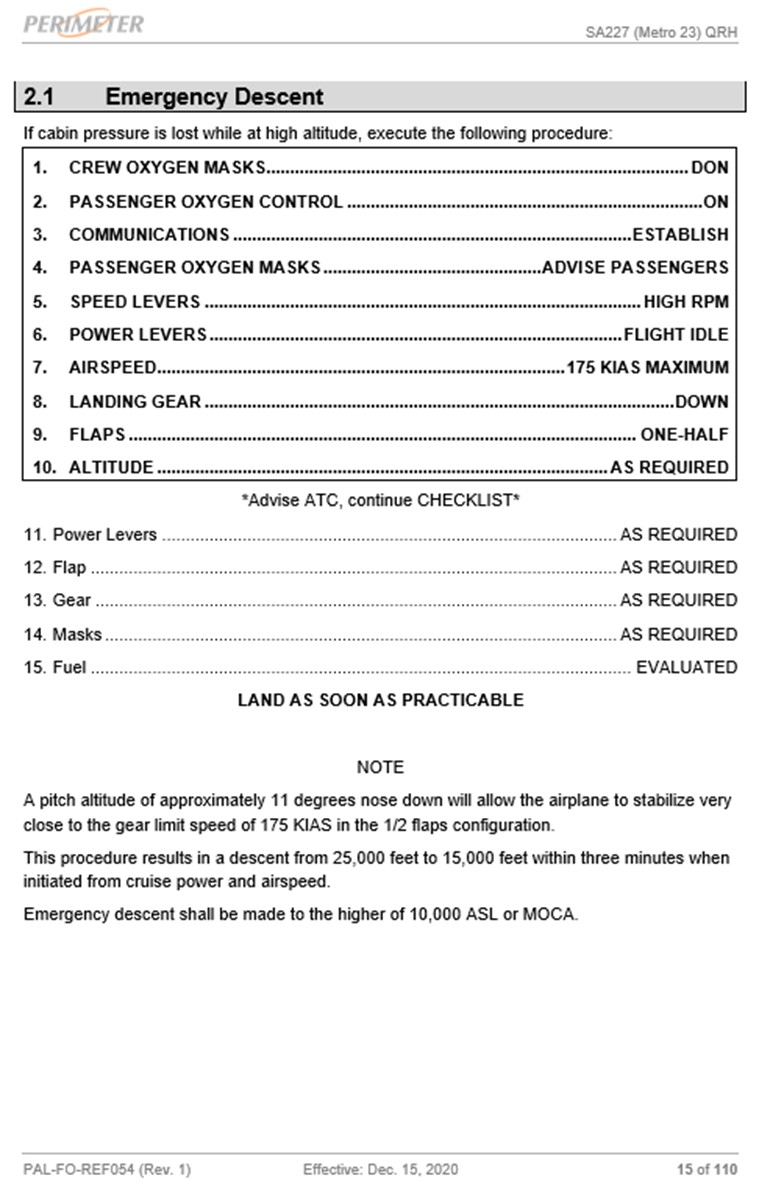
Source: Perimeter Aviation LP
Appendix B – Perimeter Aviation LP Fairchild SA227-DC Metro 23 quick reference handbook cabin – low pressure malfunction procedure
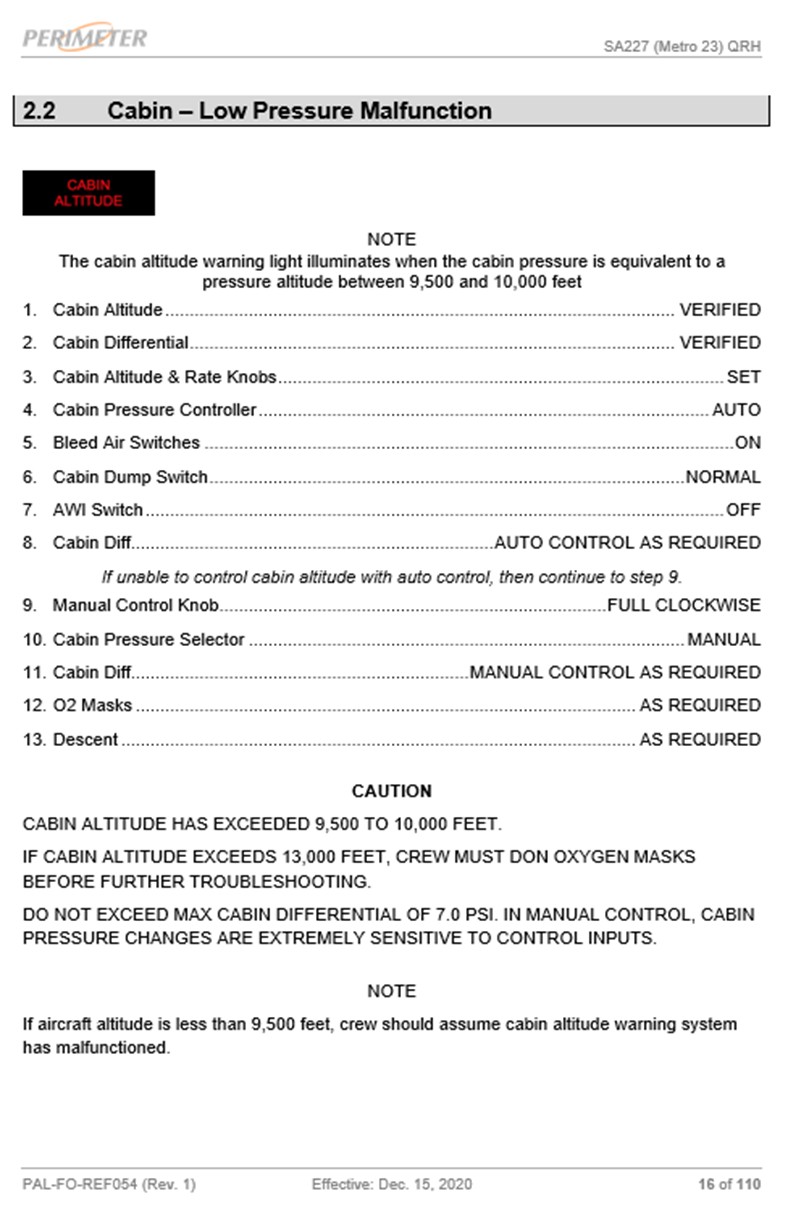
Source: Perimeter Aviation LP
Appendix C – Perimeter Aviation LP minimum equipment list
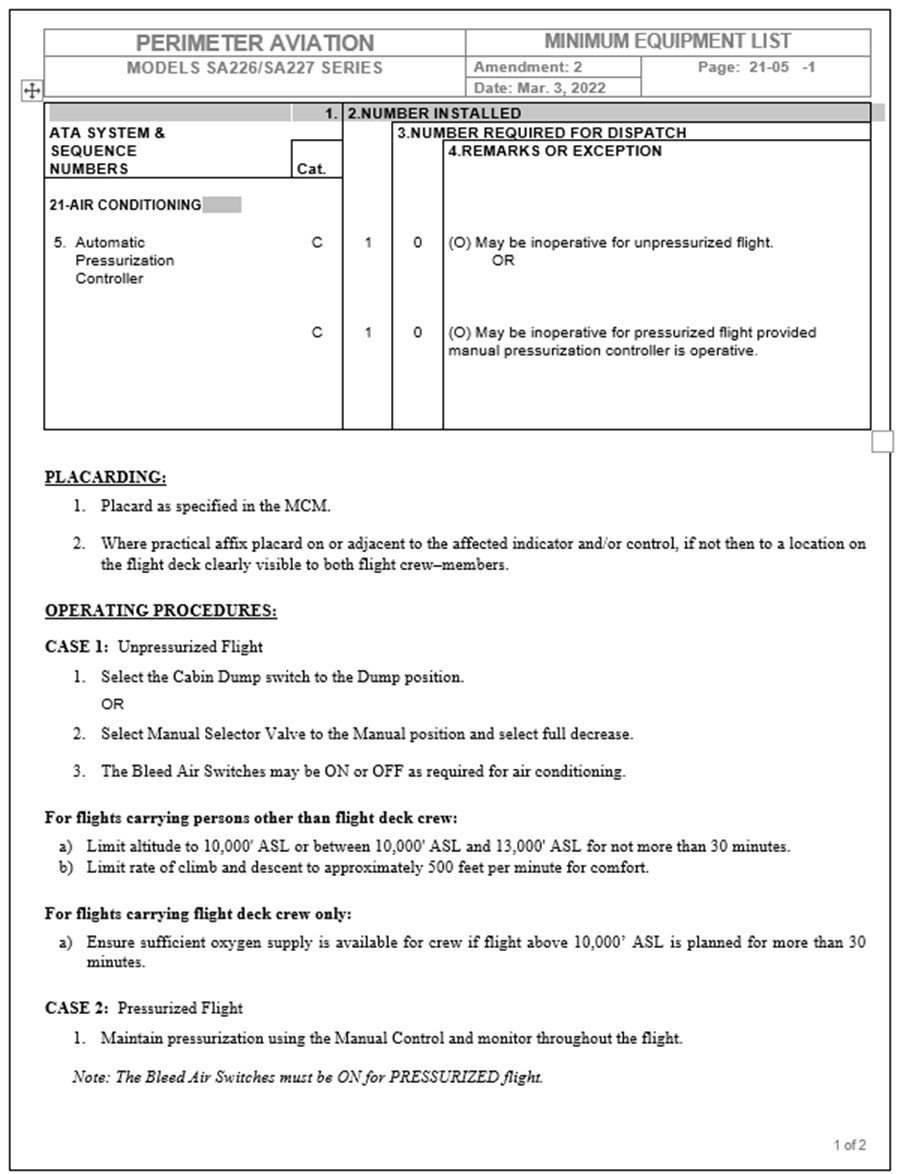
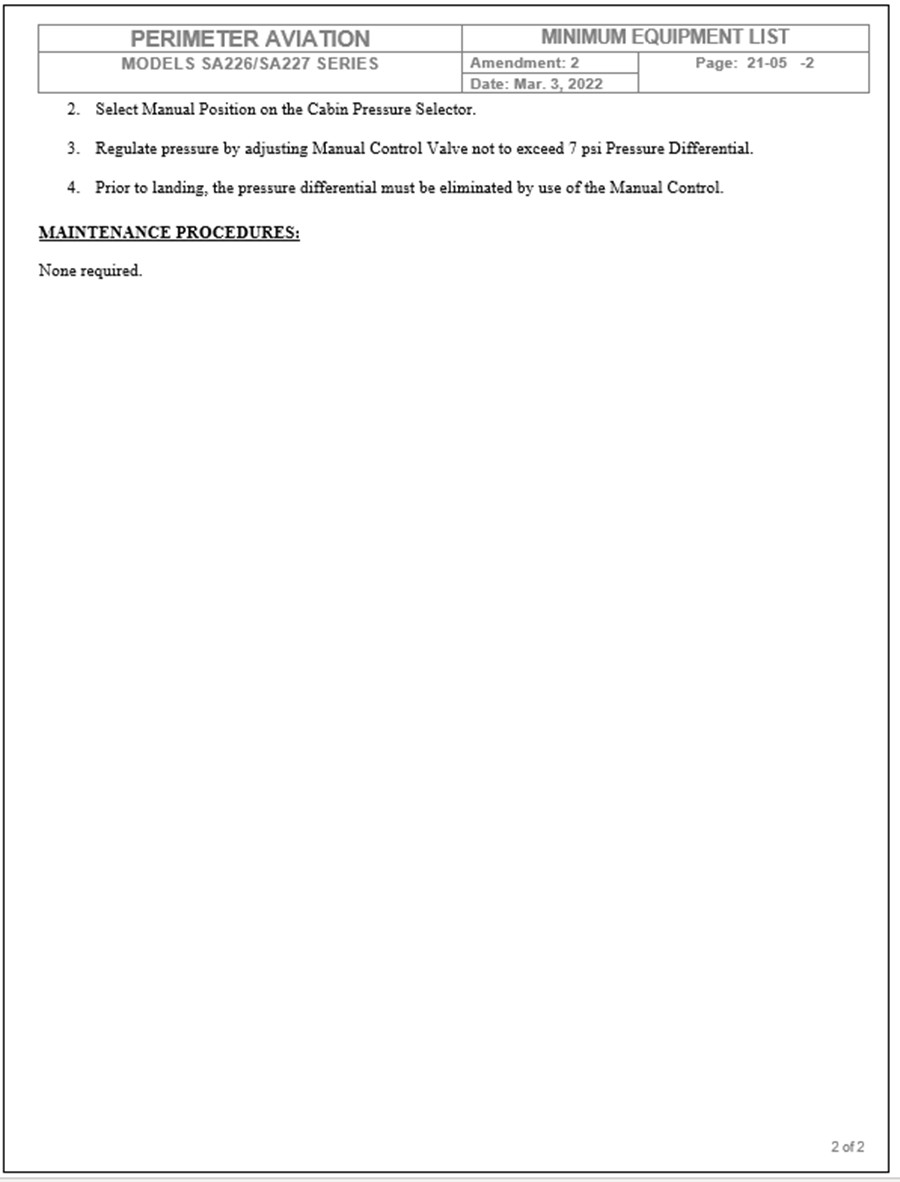
Source: Perimeter Aviation LP
Appendix D – RNAV (GNSS) Y RWY 10 approach chart at Detour Lake Aerodrome (not to be used for navigation purposes)
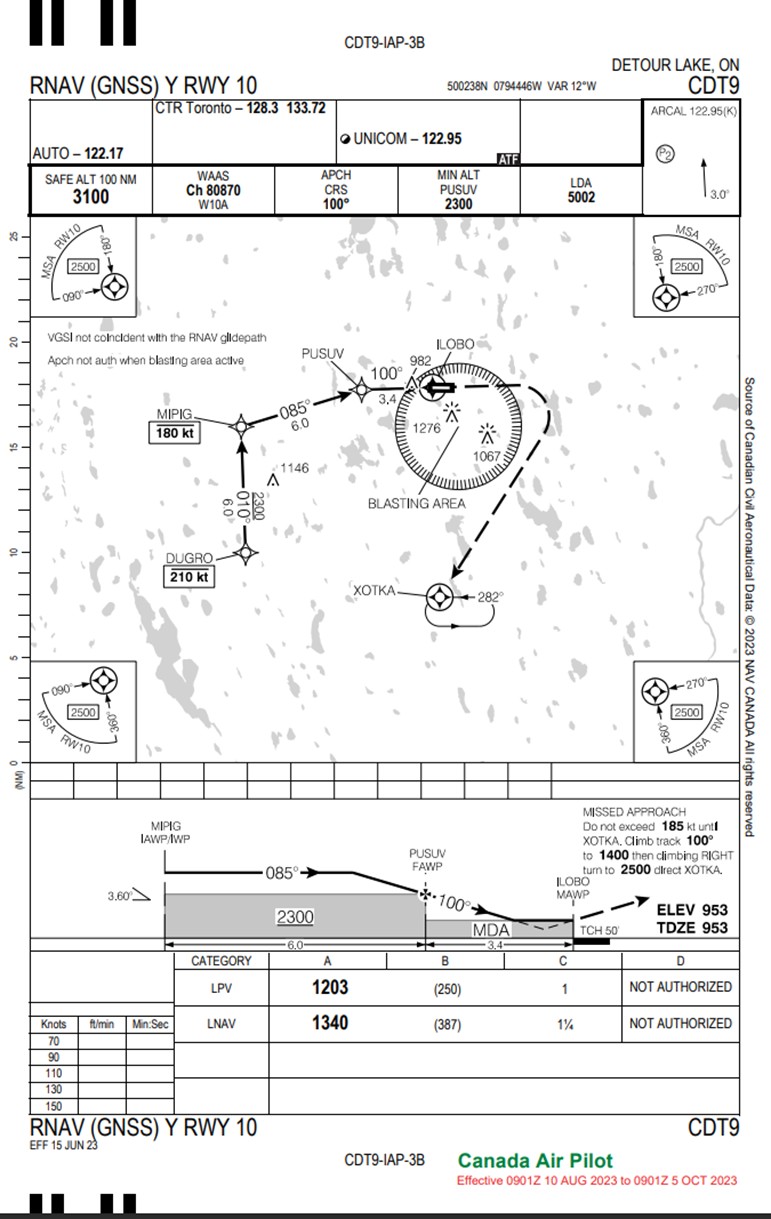
Source: NAV CANADA
Appendix E – Flight data recorder plot at time of short final to landing, indicating when the negative torque values were recorded (circled)
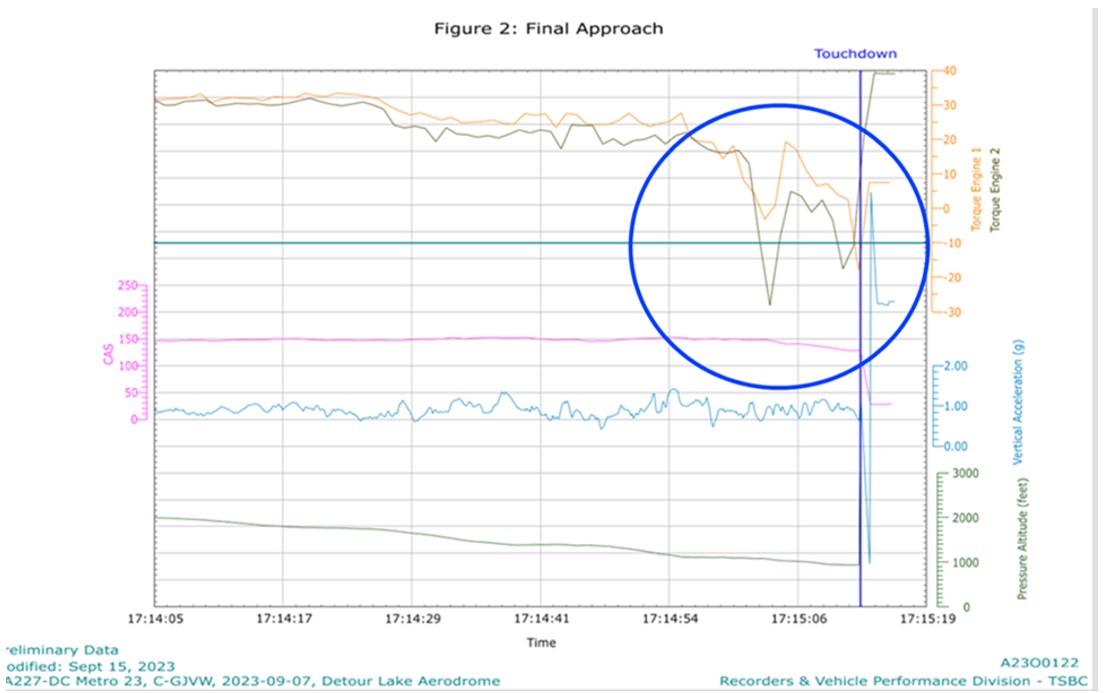
Source: TSB